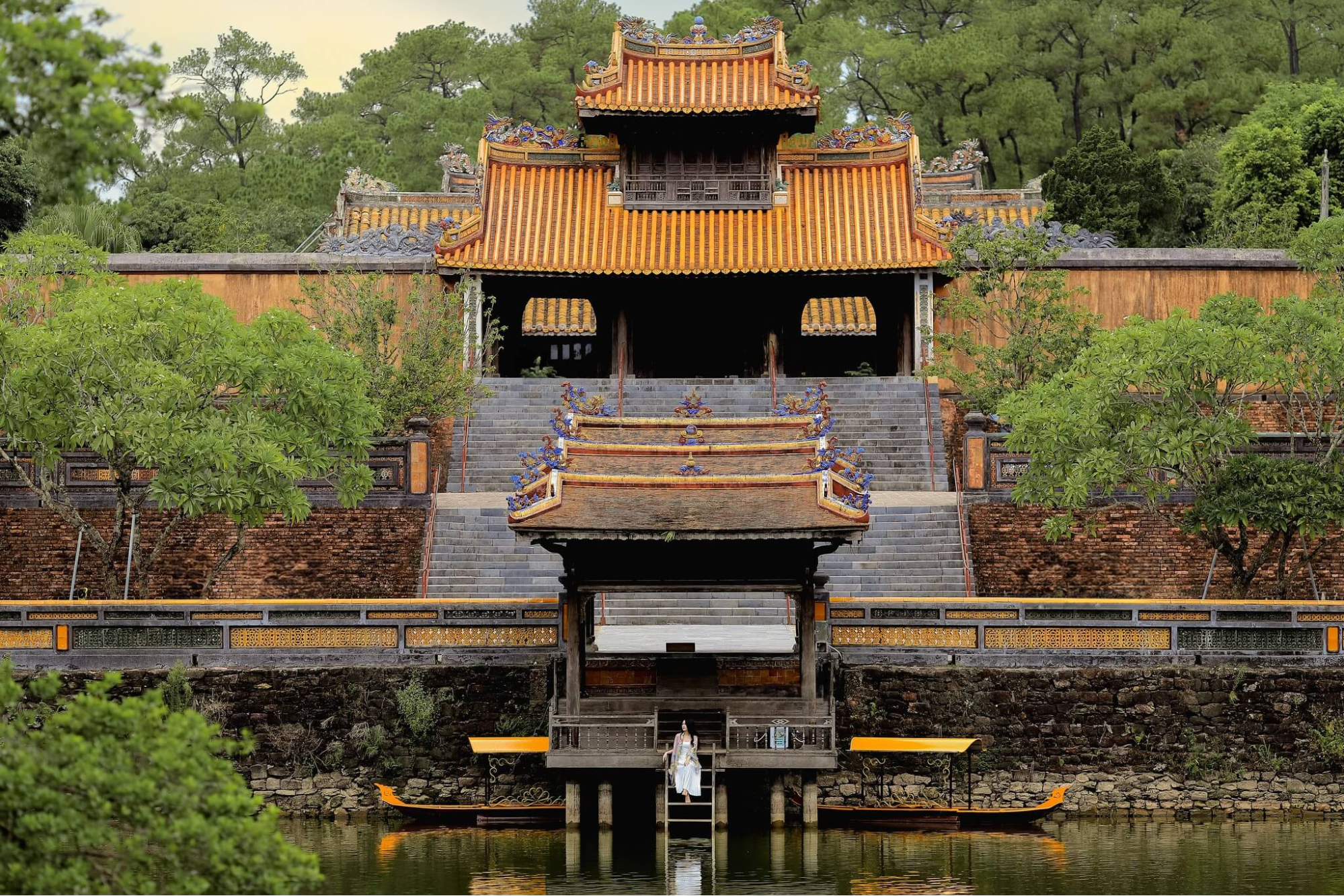
There are seven Hue royal tombs open to visitors, spread over about 20 km of hills south and west of the city. Almost nobody sees all seven, and almost nobody should try. Most travellers have time for two or three, and the honest answer is that Khải Định and Tự Đức are the two that justify their ticket price for a first visit, with Minh Mạng as the third if you want space and quiet rather than decoration.
Tickets are 150,000₫ (about $5.75) each for the three main tombs, which adds up fast. This guide covers what each one actually contains, what it costs in 2026, how far it is, and where the combined tickets save money.
Why there are only seven tombs for thirteen emperors
The Nguyễn dynasty ran from 1802 to 1945 and had thirteen emperors, but only seven tombs were built. The later reigns were short, poorly funded, or spent partly in exile under French rule, and there was neither the money nor the political stability for grand construction.
Most emperors started building while still alive, and used the site as a retreat before it became a burial ground. That is why several of these places have lakes, pavilions and theatres rather than just a grave — Tự Đức’s complex in particular was a working residence for years before it was a tomb.
At a glance
| Tomb | Ticket (adult) | Distance from centre | Time needed | Best for |
|---|---|---|---|---|
| Khải Định | 150,000₫ | ~10 km | 1–1.5 hrs | Decoration, mosaic interiors |
| Tự Đức | 150,000₫ | ~7 km | 1.5–2 hrs | Gardens, lake, scale |
| Minh Mạng | 150,000₫ | ~12 km | 1–2 hrs | Symmetry, quiet, walking |
| Gia Long | 150,000₫ | ~16–19 km | 1.5–2 hrs | Landscape, near-total solitude |
| Đồng Khánh | 100,000₫ | ~8 km | 30–45 min | Stained glass, empty grounds |
| Thiệu Trị | 50,000₫ | ~9 km | 1 hr | Pine forest, low crowds |
| Dục Đức (An Lăng) | 50,000₫ | ~3 km | 30–45 min | History, colour, city convenience |
Prices checked August 2026. Distances are by road and vary by route.
How much do the Hue royal tombs cost in 2026?
The Hue Monuments Conservation Centre sells single-site tickets and combined route tickets. The same price applies to Vietnamese and foreign visitors.
Single-site tickets:
| Site | Adult ticket | Best use |
|---|---|---|
| Imperial City | 200,000₫ | Main Hue citadel visit |
| Khải Định / Tự Đức / Minh Mạng / Gia Long | 150,000₫ each | Main royal tombs |
| Đồng Khánh | 100,000₫ | Add-on with Tự Đức |
| Thiệu Trị / Dục Đức / An Định Palace / Nam Giao Esplanade | 50,000₫ each | Short, cheaper secondary sites |
Route tickets:
| Route | Adult | Child |
|---|---|---|
| Minh Mạng + Gia Long | 240,000₫ | 30,000₫ |
| Tự Đức + Đồng Khánh | 200,000₫ | 30,000₫ |
| Imperial City + any two of Minh Mạng / Tự Đức / Khải Định | 420,000₫ | 80,000₫ |
| Imperial City + Minh Mạng + Tự Đức + Khải Định | 530,000₫ | 100,000₫ |
| All sites | 600,000₫ | 120,000₫ |
The four-site ticket at 530,000₫ (about $20) is the one that makes sense for most people. Bought separately those four cost 650,000₫. Route tickets are valid two days; the all-sites ticket is valid five days. Children under six or seven go free and 7–12 pay the child rate — the cut-off is quoted inconsistently by different sellers, so bring ID if it matters.
E-tickets are sold through the Conservation Centre’s online system and the Hue-S app, which is worth doing at the Imperial City in high season but is unnecessary at the smaller tombs, where there is rarely a queue.
Khải Định Tomb (Ứng Lăng)
Built from 1920 and finished in 1931, this is the last and the strangest of the seven. It sits on the slope of Châu Chữ hill, about 10 km from the centre, and covers only around 5,000 m² — small compared with the others, but built vertically in terraces reached by 127 steps lined with stone mandarins, elephants and horses.
The exterior is grey reinforced concrete, closer to a European mausoleum than anything else in Hue. The interior is the opposite: the Thiên Định chamber is covered floor to ceiling in mosaics made from broken porcelain and coloured glass, with a ceiling painting of nine dragons in cloud, and a gilded bronze statue of the emperor. Materials were imported from France, China and Japan at a cost that made the project unpopular at the time.
Open 7:00–17:30. Allow an hour, more if you use the free multilingual audio guide available at the entrance.
The downside: it is the busiest of the seven by a wide margin, the stairs are fully exposed, and the interior chamber is a single room that fills with tour groups. Go before 9:00 or after 15:30.
Tự Đức Tomb (Khiêm Lăng)
The largest and the most pleasant to walk. Roughly 12 hectares and close to 50 structures around a lake, all named with the character Khiêm (modesty) — a pointed choice, since the site was originally called Vạn Niên Cơ and the forced labour used to build it triggered the Chày Vôi revolt of 1866, after which the emperor renamed it.
Tự Đức used it as a residence for years: there is a working palace, a temple to his mother, and Minh Khiêm Đường, generally described as the oldest surviving royal theatre in Vietnam. He is almost certainly not buried here. The real grave was hidden to prevent looting, and its location has never been established.
About 7 km from the centre, open 7:00–17:30, 150,000₫. Allow 1.5–2 hours; it is bigger than it looks from the entrance.
The downside: as of mid-2026 the main entrance gate and parts of the complex are under restoration, with scaffolding in some of the best-known views. Paths are uneven and there are a lot of steps.
Minh Mạng Tomb (Hiếu Lăng)
Built 1840–1843 by Thiệu Trị for his father, about 12 km out at Bằng Lãng where the Tả Trạch and Hữu Trạch rivers meet to form the Perfume River. Around 40 structures are arranged on one straight axis across roughly 18 hectares, with lakes on either side — the most rigidly symmetrical of the seven, and the one that reads most clearly as a designed landscape rather than a monument.
It is also the quietest of the three main tombs, partly because of the distance. Recent visitors report far smaller crowds here than at Khải Định.
Open 7:00–17:00 according to current listings, though some sources say 17:30. 150,000₫.
The downside: the burial mound itself is closed — you can walk up to the gate and no further. Restoration work around the lake path was ongoing in mid-2026 and the ground gets muddy after rain.
Gia Long Tomb (Thiên Thọ Lăng)
The founder’s tomb, built 1814–1820, and the furthest out at roughly 16–19 km depending on the route. It is not one building but a scattered complex across a bowl of 42 hills, with Đại Thiên Thọ mountain as the screen in front and no perimeter wall at all.
The architecture is plain. What makes it worth the ride is the setting — pine and open ground, essentially empty of other visitors — and the double grave, the only one of the seven where the emperor and empress lie side by side. Bicycles are available to rent on site, which helps, as the complex is spread out.
150,000₫, with a reduced local rate. Open 7:00–17:30, with entry closing at 17:30 rather than the site.
The downside: the road is long and rough in patches, there is very little interpretation on site in any language, and if you came for architecture rather than landscape you will find it thin. Not a good choice on a rented scooter in wet weather.
Thiệu Trị Tomb (Xương Lăng)
Built in 1847 by Tự Đức for his father, on flat ground about 9 km out, with orchards and fields instead of a wall. It is the only one of the seven that faces northwest, a direction almost never used in Nguyễn court architecture — which also means the front elevation photographs badly until late afternoon.
Quiet to the point of emptiness: it has a few hundred reviews online against Khải Định’s sixteen thousand. Wooden buildings, restrained carving, a lotus pond and a stone bridge to the grave enclosure. At 50,000₫ it is the best value of the seven.
The downside: sections have been under maintenance recently and parts of the site are fenced off. There is no cafe, no shop and usually no staff beyond the ticket window.
Đồng Khánh Tomb (Tư Lăng)
Small, and interesting mainly for what the construction history did to it. Đồng Khánh died in 1888 aged 25 with the treasury empty, and the tomb was finished piecemeal over about 35 years across four reigns. The result mixes court tradition with French materials — the Ngưng Hy temple has coloured glass windows, Western roof tiles and neoclassical detailing, alongside conventional stone mandarin, elephant and horse statues in the courtyard.
Around 8 km out, close enough to Tự Đức to pair with it, and the two-site ticket covers both for 200,000₫. Allow 30–45 minutes. Single ticket 100,000₫.
The downside: there is nothing here — no vendors, no water, often no other visitors. Bring your own drink. Reported ticket prices vary between 50,000₫ and 100,000₫ depending on the source, so check at the gate.
Dục Đức Tomb (An Lăng)
The closest to the city at about 3 km, and the only one holding three emperors: Dục Đức, his son Thành Thái, and his grandson Duy Tân. Dục Đức reigned for three days in 1883 before being deposed and imprisoned, where he died. Thành Thái and Duy Tân were both exiled by the French; Duy Tân’s remains were repatriated in 1987 and buried alongside his father.
It was restored relatively recently and the temple interiors are brightly painted, which surprises people expecting something sombre. 50,000₫, and easy to fit around anything else in the city.
The downside: it is architecturally modest, and the interest is almost entirely in the history rather than what you see. Opening hours are not reliably published — go mid-morning.
Getting around, and how to combine them
Khải Định, Tự Đức, Đồng Khánh, Thiệu Trị and Minh Mạng sit in the same broad arc southwest of the city, 5–10 km apart from each other. Gia Long is well beyond them; Dục Đức is in the opposite direction, in town.
Scooter is the standard approach — 80,000–160,000₫ a day in Hue, most commonly 100,000–150,000₫, plus fuel. Roads to Tự Đức and Khải Định are straightforward. The road to Gia Long is not, and a car is the safer choice for that one.
Grab and taxi work fine but the meter runs on every leg, and drivers will not wait for free. Booking a car with a driver for a half day is usually cheaper than three separate Grab rides once you factor in waiting time.
Dragon boat on the Perfume River reaches Thiên Mụ Pagoda, Minh Mạng and Hòn Chén Temple, and is a genuinely different way to see the river. It is slow, and you still need land transport at the landing stages.
A realistic half day: Khải Định first thing, Tự Đức afterwards, back in town for lunch. A realistic full day adds Minh Mạng between them, or Đồng Khánh as a fifteen-minute detour from Tự Đức.
Practical notes
- Dress code is enforced. Shoulders and knees covered. Staff do turn people away at the gate.
- Shade is limited. Khải Định’s steps and Minh Mạng’s axis have almost none. April to August, go early.
- Cash for parking and drinks. Tickets can be paid by card or QR at the main sites; the vendors outside cannot.
- Wear real shoes. Uneven stone, loose gravel and a lot of steps at every site.
- English signage is inconsistent. Khải Định has a good free audio guide; several of the smaller tombs have almost nothing. A guide costs 100,000₫ per group at Minh Mạng, Tự Đức or Khải Định.
- Data: a local eSIM is the simplest way to keep maps and Grab working between sites — [our eSIM recommendation]
What to skip
If you have one day in Hue and want to see the Imperial City as well, do Khải Định and stop. Adding a third tomb to a single day means seeing all three badly in the heat.
Skip Gia Long unless you specifically want the landscape and have half a day and a car. Skip Thiệu Trị and Đồng Khánh on a first trip — they reward a second visit, when the famous ones are out of the way and you want somewhere with nobody in it.
Skip the tombs entirely if you are travelling with a toddler or anyone who struggles with stairs. Khải Định alone is 127 steps with no alternative route.
Budget for one day, two tombs
| Item | Cost |
|---|---|
| Scooter rental | 120,000₫ |
| Fuel | 50,000₫ |
| Khải Định + Tự Đức tickets | 300,000₫ |
| Water, parking | 40,000₫ |
| Total per person | 510,000₫ (~$20) |
Add roughly 230,000₫ per person if you take the four-site route ticket and include the Imperial City and Minh Mạng across two days — that route works out cheaper per site than paying separately.
Related Vietnam travel guides
- First Time in Vietnam: 15 Things Locals Wish Tourists Knew
- Bac My An, Han or Con Market? A Local’s Honest Guide to Eating at Da Nang’s 3 Markets
- 5 Hoi An Dishes That Will Ruin All Other Food For You
FAQ
Which Hue tomb should I visit if I only see one? Khải Định. It is the closest thing to unmissable, the interior is unlike anything else in Vietnam, and it takes the least time.
Are the tombs worth 150,000₫ each? Khải Định and Tự Đức, yes. The others are worth it if you have already seen those two and want quiet. At three tombs the cost approaches the four-site route ticket, so buy the route ticket instead.
Can you visit the tombs in half a day? Two, comfortably. Three is possible but rushed and, in summer, unpleasant.
Is Emperor Tự Đức actually buried in his tomb? Almost certainly not. The burial site was concealed and the workers involved are said to have been killed. It has never been found.
Do I need a guide? Not for Khải Định, which has a good audio guide. For Minh Mạng and Gia Long a guide adds a lot, because the layouts carry meaning that is not signposted.
Been to any of these recently, or found a route through them that worked better? Tell us in the comments — we update this guide as ticket prices and restoration work change.