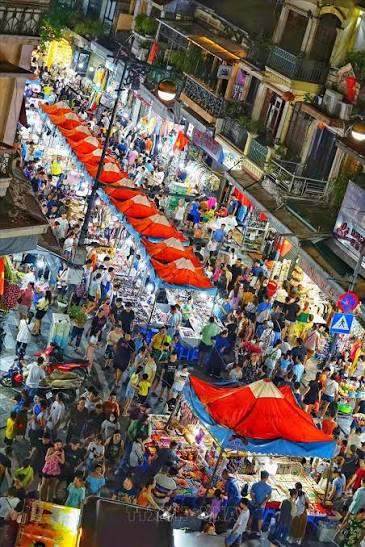
Most people who say they’re going to “Đồng Xuân night market” are actually about to experience three different things stacked on top of each other, and mixing them up is the easiest way to have a disappointing trip. There’s the indoor market itself, open daily and closed by early evening, run mostly for locals and small businesses rather than visitors. There’s the weekend clothing-and-souvenir street market that only exists Friday through Sunday, loud and packed and half date-night ritual for young Hanoians. And there’s the food alley behind the building, which runs most nights whether or not the shopping street is open, and which locals point to as the reason to come back even after the souvenirs stop being interesting. Knowing which one you’re walking into changes what you should expect.
Food 4/5 · Shopping 3/5 · History & Atmosphere 4.5/5 · Value 3.5/5 — Overall 4/5
Quick facts
- Where: the market building sits at the top of the Old Quarter, bordered by Đồng Xuân Street, Hàng Khoai Street, Cầu Đông Street, and the Đồng Xuân market alley. Administratively, this is now inside Phường Hoàn Kiếm — Hoàn Kiếm district was dissolved on July 1, 2025 and folded, along with several surrounding wards, into one new ward carrying the old district’s name.
- Indoor market hours: roughly 6am–6pm, daily. This is the wholesale-and-retail building itself, not the night market.
- Weekend night market: Friday, Saturday, Sunday only, from around 6pm to somewhere between 10:30pm and 11:30pm depending on the source — plan to be done browsing by 10pm to be safe. This is the part that closes Hàng Đào, Hàng Ngang, and Hàng Đường streets to traffic and runs south from the market almost to Hoàn Kiếm Lake.
- The food alley: the lanes around the back and sides of the building (sometimes referred to locally as Chợ Bắc Qua) run food stalls most evenings, not just weekends — this is the detail most visitors miss, and the reason showing up on a Tuesday isn’t a wasted trip if food is what you’re after.
- Cash only almost everywhere in and around the market.
A market with an actual history
Đồng Xuân’s story starts around 1804, as a riverside trading spot along the Tô Lịch River. When the French filled in that stretch of river in 1889, colonial authorities relocated the merchants and built the market that still stands, with its distinctive facade of five triangular gables punched with honeycomb-pattern vents and five arched entrances.
A fire in 1994 gutted most of the building and destroyed an estimated $4.5 million worth of stock — one of the more significant disasters in the market’s history. It was rebuilt to its original external form, which is why the building still reads as 19th-century French colonial despite being largely reconstructed. A relief sculpture near the market, “Hanoi Winter 1946,” commemorates residents who died defending the city that year — worth a look on the way in, and easy to miss if you don’t know to look for it.
Inside the building, floor by floor
The ground floor is clothing, shoes, and accessories, heavy on imported goods from the Chinese border trade through Móng Cái, Lạng Sơn, and Lào Cai — this is the wholesale core of the market and it looks it. The second floor shifts to fabric, from cheap synthetic bolts to better-quality material, aimed as much at tailors and small businesses as at individual shoppers. The third floor is children’s clothing, toys, and baby gear.
The rear of the building has historically held a small pet and bird section. If wildlife trade is something you’d rather not walk past, it’s easy to skip — the shopping and food elsewhere in the market don’t route you through it.
The weekend night market: Hàng Đào to Đồng Xuân
Once Friday evening hits, the streets leading up to the market from Hoàn Kiếm Lake close to vehicles and fill with stalls — close to 4,000 of them across the full stretch. This is a different inventory from the daytime building: clothing, phone cases, belts, jewelry, silk scarves, lacquerware, ceramic figurines, and souvenirs, mostly mass-produced with some handmade pieces mixed in. Prices for small items run from a few tens of thousands of đồng into the low hundreds of thousands; food and snacks range from a few thousand đồng up to 100,000–200,000₫ for larger dishes.
On bargaining, published accounts genuinely disagree — some describe fixed, take-it-or-leave-it pricing on most items, others describe starting prices built for negotiation, particularly on anything above a couple hundred thousand đồng. The safest approach is to treat it stall by stall: ask the price, and if it feels high for what you’re looking at, counter once and see what happens rather than assuming either extreme is universal.
The loudest, most crowded window is 8–10pm, and accounts describe the crowd itself as much of the draw — young couples treating it as a regular Friday or Saturday walk, hand in hand between stalls, alongside residents doing ordinary shopping and tourists there for the heritage-street setting. It reads less like a market built for visitors and more like a market visitors have been let into.
Weekend evenings sometimes bring traditional performances near the market entrance — different accounts mention chèo (traditional Vietnamese opera), ca trù (sung poetry with lute accompaniment), and xẩm (a Hanoi street-singing tradition tied to the old “36 phố phường,” the 36 guild streets of the Old Quarter), and it’s not clear whether all three rotate through or whether accounts are describing different nights. At least one source is upfront that the performances are staged partly for visitors rather than a spontaneous local habit — worth knowing going in. Treat it as a possible bonus rather than something to plan your evening around, since none of the sources agree on a fixed schedule.
The food alley behind the market
This is the part worth making a special trip for, and it’s open far more often than the shopping street. The lanes around and behind the building — Cầu Đông, Hàng Khoai, and the smaller alleys locals call Chợ Bắc Qua — run food stalls most evenings into the night, independent of whether the Friday–Sunday clothing market is happening.
Dishes that turn up consistently across recent write-ups: cháo sườn sụn (rice porridge with cartilage rib), bún ốc (snail noodle soup), bún chả (grilled pork with rice noodles), bánh tôm (shrimp fritters), bánh giò (savory rice dumpling wrapped in banana leaf), bánh đúc (savory rice cake), bánh rán (fried glutinous rice balls), nem chua rán (fried fermented pork rolls), grilled skewers, phở, ô mai (preserved fruit), and chè (sweet dessert soup) in a dozen variations. Typical prices land in the 15,000–35,000₫ (~$0.55–$1.35) range per dish. More than one account frames this specifically as quà vặt thôn quê — countryside-style snacks — the kind of thing locals say you won’t find packaged the same way at the newer night markets further from the centre.
A few specific stalls come up repeatedly in recent guides — a bún riêu with cartilage rib near 84 Nguyễn Thiếp, a bún chả served with bamboo skewers run by a vendor known as Cô Nga, a cháo sườn sụn stall known as Huyền Anh, and a chè stall known as Cô Tuyết. Treat these as leads worth chasing rather than guarantees — small food-stall businesses move, change hands, and close, and none of this was confirmed on-site for this post. Asking anyone nearby for directions to a named vendor tends to work better than a pin on a map.
Getting there and parking
From Hoàn Kiếm Lake, it’s a five-to-ten-minute walk north along Hàng Đào and Hàng Ngang. Bus routes 09, 14, and 36 serve the area if you’d rather not walk. By Grab, expect to be dropped short of the market itself once the weekend night market is running, since the core streets close to vehicles.
Parking is the one part of this trip worth planning ahead for. There’s a metered municipal lot on Bảo Khánh Street, near the lake, running around 10,000₫ (~$0.40) for an evening — worth aiming for over informal roadside parking, where overcharging is a documented, recurring complaint rather than an occasional one.
The downside
Two things drag this down from a great experience to a good one. First, motorbike parking around the market and the night market streets has a real reputation for overcharging visitors who don’t know the going rate, with limited enforcement to stop it. Second, most of the clothing and souvenir stock on the ground floor and the weekend night market is imported, mass-produced, and inconsistent in quality — this is a place to buy something cheap and disposable, not something you’re trusting to hold up.
The confusion between the three layers — day market, weekend night market, food alley — also costs people trips. Showing up on a Tuesday expecting a lively night market street is a letdown; showing up on a Tuesday for the food alley is fine.
Who it’s for
Worth a visit for the history and the food alley alone, even outside the weekend — it’s one of the few spots in the Old Quarter where you’re eating in a market that’s been feeding the city, in some form, for over two centuries. Add the weekend night market if your dates line up and you want the atmosphere of a closed street packed with stalls, not because you’re counting on serious bargains.
Skip the ground-floor shopping if quality matters to you, and skip the whole building on a weekday evening if a lively night market street is specifically what you’re after — that part genuinely doesn’t exist Monday through Thursday.
Verdict
Đồng Xuân earns its reputation less as a shopping destination than as a place that’s been continuously feeding and supplying Hanoi since the 1800s, fire and all. Go for the food alley on any night, add the weekend street market if your timing allows, keep expectations modest on the shopping quality, and settle your parking price before you hand over your keys.