.jpeg)
Hoi An at night is worth exactly one evening if you plan it, and a frustrating two hours if you don’t. The lanterns are real, hand-made and genuinely everywhere. So is the crowd: between about 7:00pm and 8:30pm the riverfront near the Japanese Bridge is close to shoulder-to-shoulder, and most visitors spend that window queuing for the same photograph. Arrive before 6:00pm or stay past 8:30pm and it becomes a different town.
One thing to note before you plan: since 1 July 2025 Hội An is no longer a city in Quảng Nam province. Quảng Nam merged into Đà Nẵng, and the Ancient Town now sits in Hội An ward, Đà Nẵng. Older maps, taxi apps and guidebooks still say Quảng Nam. Nothing about the streets changed — only the address you’ll see on newer restaurant listings.
The switch at six o’clock
At five in the afternoon the Ancient Town is quiet and yellow. The ochre walls hold the last of the light, tailors are folding up, and the streets still have motorbikes on them.
Then the vehicle ban starts. Motorised traffic is cleared from the Ancient Town streets in the evening, generally from 6:00pm to about 9:30pm in the wet season and 10:00pm in the dry season, with a shorter morning window too. Within twenty minutes the sound changes completely: no engines, just conversation, plastic stools scraping, and the boat touts calling from the water.
The lanterns go on around the same time. They are silk stretched over bamboo frames, still made locally, and hung along house fronts, shop awnings and the bridges rather than strung in one photogenic block. The strongest view is not from the middle of the crowd but from either bridge, looking down the river at the reflections.
What Hoi An at night actually costs
The Ancient Town ticket. 120,000₫ for foreign visitors, 80,000₫ for Vietnamese visitors — about $4.60 and $3.10 at the Vietcombank rate of 26,260₫ to the dollar on 2 September 2026. Children under 1m go free; 1m–1.4m pay 50,000₫. The ticket funds heritage conservation and admits you to a set number of the town’s historic houses, assembly halls and museums.
Sources disagree on the detail: some list three sites per ticket, others five, and validity is variously described as same-day or 24 hours. Ask at the booth when you buy — the staff will tell you exactly what the current ticket covers. Enforcement in the evening is inconsistent, and plenty of visitors walk the streets without one. Buy it anyway if you plan to enter any of the old houses.
Everything else, roughly: a bowl of cao lầu at 30,000–50,000₫ · a paper lantern at 5,000–20,000₫ · a bài chòi card at around 20,000₫ · a bánh mì at 25,000–50,000₫ depending on filling, going by what recent diners report. A full evening — ticket, boat, two lanterns, dinner from street stalls, a beer — lands somewhere around 400,000–500,000₫ per person. Bring cash in small notes. Most stalls do not take cards.
The Hoài River: boats, and how not to overpay
The stretch that matters is roughly one kilometre, from the An Hội bridge down to the Cẩm Nam bridge. Boats gather along Bạch Đằng at the foot of the An Hội bridge, and the crush is heaviest between 6:00pm and 8:00pm.
Six official ticket counters, run by the Hoài River tourism management board, sit along the riverbank near the bridge. Prices are set there. Away from those counters there is no posted rate, which is why published figures range from 50,000₫ a head for a shared boat to well over 200,000₫ for a small private one — everyone quotes a different number because everyone is quoted a different number.
A few things that keep this simple. Buy at a counter rather than from whoever reaches you first on the path. Agree the price for the whole boat, not per person, and confirm how many people that covers before you step in. Ask how long the ride is — twenty minutes is standard, and being returned after eight is the most common complaint. Confirm whether lanterns are included or extra, since that is where the price usually moves. Wear the life jacket; they are on board for a reason. And pay at the end.
If you want the ride without the scrum, go at around 5:30pm. The light is better for photographs, the lanterns are already lit, and the queue has not formed yet.
Hoa đăng: what you’re actually doing
The paper lotus lanterns floating on the Hoài are called hoa đăng, and releasing one is a prayer rather than a photo prop. The practice is rooted in Buddhism: each lantern carries a wish, most often for peace, health and good fortune for family members, including those who have died. Locals release them on the first and fourteenth nights of the lunar month, and in much greater numbers at Vu Lan, Phật Đản and Tết Nguyên Tiêu.
Physically it is very simple. You buy a lantern from a seller on the bank — a folded paper lotus around a small candle — light it, and set it on the water. From the bank, sellers lend you a long-handled net so you can lower it without leaning in. From a boat you lean over the side, take it in both hands, and let it go flat so it doesn’t tip. Then you watch it drift. On a busy night there are hundreds on the water at once, and the reflection off the surface is the reason most people came.
How to do it without being the person everyone winces at: buy one or two, not a dozen for a photo sequence. Give it a moment before you photograph it. Don’t reach into the water to reposition someone else’s. If a family nearby is clearly praying rather than sightseeing, leave them the space.
Two honest caveats. The lantern sellers, many of them children, are persistent, and visitors regularly describe being followed along the bank until they buy — a firm, friendly “không, cảm ơn” and continuing to walk is the normal response. And several thousand candles and paper cups a night is not nothing environmentally; collection crews work the river, but the litter is visible. Some visitors find the whole thing more commercial than spiritual. Both things are true at once, which is roughly the state of Hoi An generally.
The 14th night of the lunar month
Once a month the Ancient Town cuts its electric lighting and runs on lanterns alone. This is Đêm Rằm Phố Cổ, the full-moon eve — the fourteenth night of the lunar month, not the fifteenth, which is the detail most English listings get wrong.
For the remainder of 2026 that falls on 24 September, 23 October, 22 November and 22 December. Published accounts of the blackout window disagree — some say lights out from 6:00pm, others from 8:00pm, most agree it runs until about 10:00pm — so ask your accommodation on the day. It is by some distance the best night to be here, and also the busiest.
Bài chòi, the game you’ll hear before you see
At Vườn tượng An Hội, the open ground by the river on the An Hội side, a set of bamboo huts is arranged around a central one. From 7:00pm nightly, two performers known as anh Hiệu and chị Hiệu draw cards and announce each one not by name but by singing a short verse in the Quảng dialect, often a joke or a riddle. Players sit in the huts holding cards; when you hear yours, you shout. The first to match all three wins, usually a lantern or a small souvenir.
A card costs around 20,000₫ and you buy it on the spot. The game is included in the free street-performance programme that runs roughly 7:00pm to 8:30pm nightly for ticket holders.
The drawback is obvious: it’s entirely in Vietnamese, in a regional dialect, and even fluent Vietnamese speakers from Hanoi miss half the jokes. Staff will help foreign players follow along, but you will be following the rhythm and the crowd’s reactions rather than the words. Watching for fifteen minutes without playing is a perfectly good use of the time, and it costs nothing.
A night food crawl, sitting on the low stools
Skip the riverside restaurants with laminated six-language menus and a man outside waving one at you. The prices are two to three times the street rate and the cooking is aimed at people who will only eat there once.
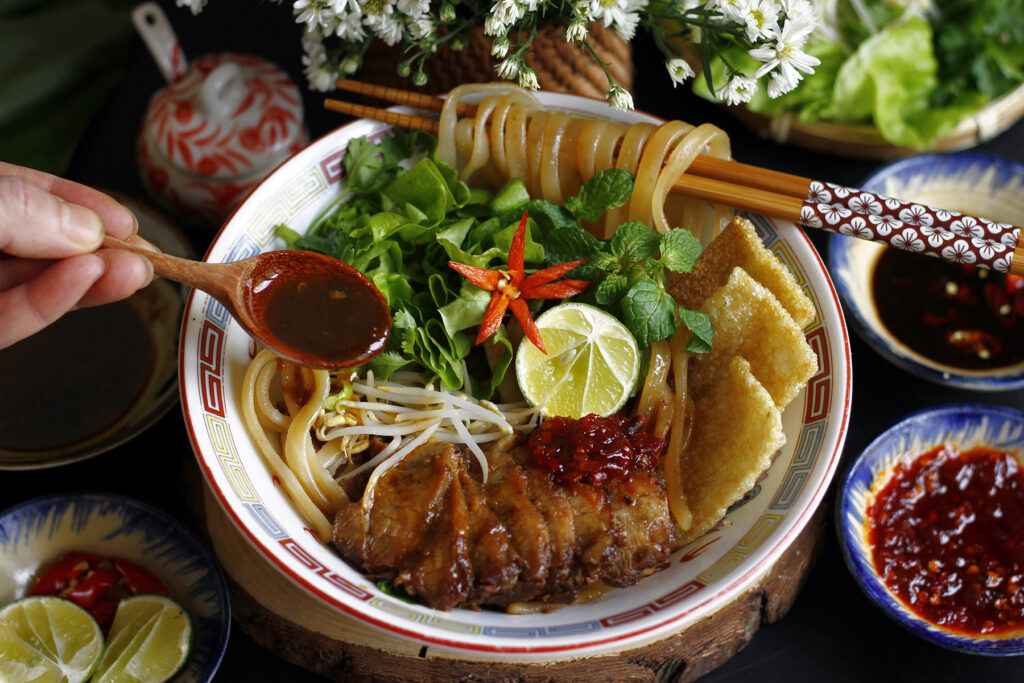
Cao lầu is the dish Hoi An actually owns. Thick rice noodles made with lye water — traditionally drawn from the Bá Lễ well — topped with sliced char siu pork, crisp fried noodle squares, bean sprouts and herbs from Trà Quế, with only a few spoonfuls of dense broth at the bottom. It is closer to a dressed noodle salad than a soup. Expect 30,000–50,000₫.
For an evening bowl, Cao Lầu Bá Lễ on Trần Hưng Đạo runs until about 9:30pm and is busy with both locals and visitors — you may wait fifteen minutes at dinner time. Cao Lầu Bà Bé, a stall in the Hội An market food court, serves until about 9:00pm and has a Vietnamese-English menu you can point at. Note that the much-recommended Cao Lầu Thanh on Thái Phiên closes at 7:00pm most days, closes early on Wednesdays and shuts entirely on Thursdays, so it is a lunch plan, not a night one.
Chè bắp is the sweet worth ordering after: young corn cut from the cob and cooked into a thin, barely-sweet pudding, served with a spoon of coconut cream, sometimes warm and sometimes over ice. The corn traditionally comes from the sandbanks at Cẩm Nam, across the bridge, which is also where you’ll find bánh đập and hến trộn — the smaller, quieter eating strip most visitors never cross the river to reach. Prices there are posted at the stalls; ask before ordering, since they aren’t published anywhere reliable.
Bánh mì is the late option, with one correction to make. Bánh Mì Phượng at 2B Phan Châu Trinh closes at 9:00pm. Madam Khánh at 115 Trần Cao Vân closes between 7:00pm and 10:00pm depending on the day. Neither is a genuine late-night stop. After about 9:30pm your options are the street carts on the edges of the Ancient Town and around the market, which is where the locals eat anyway.
Nearly all of this is cash only, and change for a 500,000₫ note is a problem at a stall selling 30,000₫ bowls.
Getting away from the crowd
The crush is geographically small. It concentrates in three places: the Japanese Bridge, the An Hội bridge, and the night market on Nguyễn Hoàng. Walk two blocks in any direction from those and the density drops sharply.
Three practical moves. Walk east, away from the Japanese Bridge and past the market, where the streets are still lantern-lit but the tour groups thin out. Cross the bridge to Cẩm Nam, which most day-trippers never do. Or simply wait: large tour groups are typically back on their coaches by around 8:30pm, and the streets between then and 10:00pm are the best version of the evening.
The Japanese Bridge — Chùa Cầu — reopened on 3 August 2024 after a nineteen-month restoration costing over 20 billion đồng. Be prepared for a debate you may not have expected: the restored bridge drew significant criticism in Vietnam for looking too new, with the conservation centre responding that the original colours were retained and only replaced timber and re-laid roof tiles read as fresh. At night, lit, the difference is much less pronounced than in the daytime photographs that caused the argument.
The night market on Nguyễn Hoàng, on the An Hội side, is the main lantern-and-souvenir strip. First prices are set high and bargaining is expected: one counter-offer at roughly half, delivered with a smile, and a willingness to walk away is normal and not rude here. Reviewers consistently note that leather goods inside the market cost noticeably more than the same items in shops outside it. Don’t bargain at food stalls where prices are displayed — that’s not how it works.
Getting in and out. Grab and taxis can’t enter the Ancient Town during the pedestrian hours, so you’ll be dropped at the edge and walk in — usually five to ten minutes. Agree the fare or use the app price; the drivers waiting outside the pedestrian zone late at night are the ones most likely to quote a flat rate well above the meter.
Timing across the year. October to December is the wet season, and the Hoài floods most years. Boat services stop when the river is high, and parts of the Ancient Town street level go underwater in a bad week. If you’re travelling then, keep the lantern evening flexible rather than booking it for one fixed night.
FAQ
What time do the lanterns come on in Hoi An? Around 6:00pm, together with the start of the evening vehicle ban. They stay lit until roughly 10:00pm, when the town winds down quickly.
Do I need the Ancient Town ticket to see the lanterns at night? Officially all visitors to the Ancient Town buy one; in practice evening checking is inconsistent, and you can walk the streets and the riverbank without entering any ticketed building. You do need it for the historic houses, assembly halls and museums.
How much should a boat on the Hoài River cost? There is no single published rate. Buy at one of the six official counters near the An Hội bridge, agree a price for the whole boat rather than per person, confirm the ride is twenty minutes, and check whether lanterns are included.
Is Hoi An at night worth it if I only have one evening in Da Nang? Yes, but arrive by 5:30pm rather than 7:00pm. Hoi An is roughly 30km from central Da Nang, so allow 45 minutes each way by car, longer on a Saturday.
When is the monthly lantern festival? The fourteenth night of each lunar month, when the Ancient Town switches off its electric lights. For the rest of 2026: 24 September, 23 October, 22 November and 22 December.
The short version
Come at 5:30pm, take the boat before the queue builds, release one lantern and mean it, eat sitting on a low stool rather than a riverside terrace, and stay past 8:30pm when the coaches leave. The Ancient Town has been receiving visitors for four hundred years and has been very thoroughly discovered, which is a fact to plan around rather than a reason to skip it.