Quick booking links:
Let me tell you something the glossy travel guides won’t: Hoi An is not a food destination. It’s a food ambush.
You come for the lanterns and the tailor shops. Then somewhere between the Japanese Bridge and the river, a smell grabs you by the collar — charcoal smoke, pork fat, fresh herbs — and suddenly your itinerary is dead. Good. Let it die.
Here are the five dishes worth surrendering to. Eat them in this order, or don’t. But eat them.
🍜 CAO LAU — THE DISH THAT EXISTS NOWHERE ELSE ON EARTH
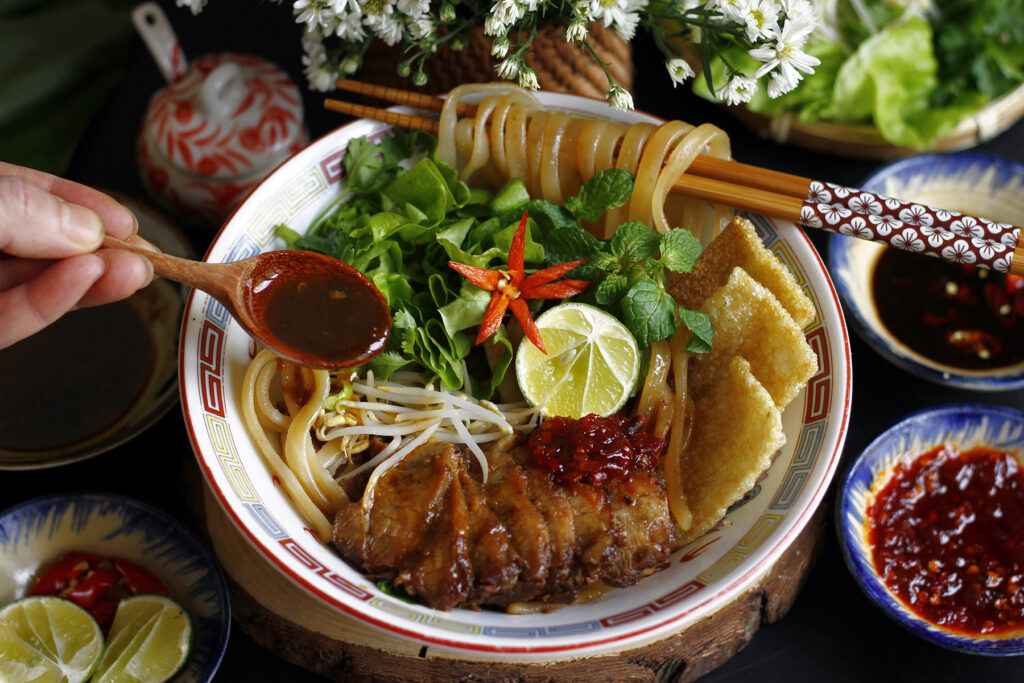
Cao lau is Hoi An’s flex. The noodles are chewy, golden, almost smoky — made with lye water that, according to every grandmother in town, must come from wells and ash connected to Cham Island. Is that entirely true anymore? Debatable. Does it matter? No.
You’ll get a shallow bowl: thick noodles, slices of char siu-style pork, crispy noodle croutons, and a mountain of fresh greens from Tra Que village. Barely any broth. That’s the point.
Listen for the clatter of the old town’s morning — bicycle bells, cleavers on wooden boards — and eat it at a low plastic table where your knees don’t fit. A proper bowl runs around 40,000–50,000 VND ($1.60–$2). If you’re paying 120,000 in an air-conditioned “heritage restaurant,” you’re eating the tourist version.
🍗 COM GA — CHICKEN RICE THAT TAKES ITSELF SERIOUSLY
On paper, com ga is simple: rice, shredded chicken, herbs. In reality, it’s a quiet masterpiece.
The rice is cooked in chicken broth with fresh turmeric until every grain turns gold and glossy. The chicken — proper free-range gà ta, lean and flavorful — gets torn by hand and tossed with onion, rau răm (Vietnamese coriander), and a pinch of salt and pepper.
The old-school spots like Ba Buoi have queues for a reason. Go around 5pm, when the heat softens and the whole street smells like broth and lime leaves. Expect 35,000–50,000 VND ($1.40–$2) a plate.
🌹 WHITE ROSE DUMPLINGS — PRETTY, DELICATE, DANGEROUS
Banh bao banh vac — “white rose” — looks like something you’d frame, not eat. Translucent rice-paper petals wrapped around shrimp and pork, topped with crispy fried shallots.
One family in Hoi An has been making these for generations, and most restaurants in town buy from them. So yes, quality is weirdly consistent across the old town.
They’re light. Deceptively light. You’ll order one plate “just to try” and then order two more. A plate of about ten runs 70,000–100,000 VND ($2.80–$4). The sweet-sour dipping sauce is doing serious work here — don’t skip it.
🥣 MI QUANG — THE PEOPLE’S NOODLE
If cao lau is Hoi An in a tuxedo, mi quang is Hoi An in pajamas — comfortable, generous, zero pretense.
Wide rice noodles sit in just a few centimeters of intensely concentrated broth, usually shrimp and pork, sometimes chicken. On top: roasted peanuts, fresh herbs, and a giant sesame rice cracker you’re supposed to crush over everything like edible confetti.
This is breakfast food for locals. Eat it before 9am when the pots are freshest, steam rising into the cool morning air, motorbikes idling past your table. Around 30,000–45,000 VND ($1.20–$1.80) a bowl.
🌽 CHE BAP & MOT — THE SWEET GOODBYE
End your night the way Hoi An locals do: dessert on the street.
Che bap is a warm, silky corn pudding made with sweet corn from Cam Nam islet, just across the river. It tastes like childhood, even if it isn’t your childhood. Around 10,000–15,000 VND ($0.40–$0.60) a cup.
Then there’s Mót — that famous little stand with the lotus flower in every cup. Herbal tea with lemongrass, honey, and lime, sipped standing in the lantern glow while the crowd flows past. About 15,000–20,000 VND ($0.60–$0.80). Yes, it’s Instagram-famous. It’s also genuinely good. Both things can be true.
💡 HOW NOT TO EAT LIKE A TOURIST IN HOI AN
Eat where the plastic stools are. The lower the stool, the better the food. This is science.
Late afternoon is golden hour for street food — vendors are fully set up, the lunch rush is over, and the light makes everything look delicious (because it is).
Total damage for all five dishes in one glorious day: roughly 200,000 VND ($8). That’s the best $8 you’ll spend in Vietnam.
And if you’re planning your route through the old town first, check our full Hoi An guide — or pair this food crawl with a day trip from Da Nang guide just 45 minutes away.
Come hungry. Leave changed.
.jpeg)