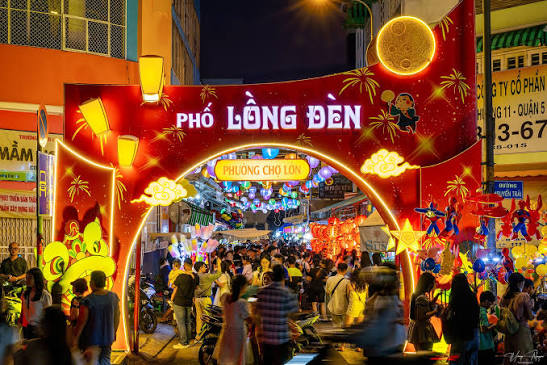
Some streets only come alive for a few weeks a year. Luong Nhu Hoc is one of them.
For eleven months it is an ordinary lane in Cho Lon, Saigon’s Chinatown, packed with narrow shophouses and no particular reason for a visitor to walk down it. Then the eighth lunar month begins and the whole row switches its lights on at once. Carp, stars, jade rabbits, butterflies, earth gods. Thousands of lanterns hang from shopfront to balcony, and the street becomes the place the entire city goes.
Mid-Autumn Festival falls on Friday 25 September 2026, so the lantern season runs from roughly 11 September. It is worth the trip, particularly if you want a child to carry a real handmade lantern rather than a supermarket one. But which evening you pick decides almost everything about how it goes, and that comes at the end of this post.
A Chinese-Vietnamese trade, fifty years deep
Luong Nhu Hoc sits in the oldest Chinese-Vietnamese neighbourhood in Saigon. Lanterns have been made by hand here for more than half a century, long enough that the street is a childhood memory for several generations of the city.
What separates it from an ordinary stall market is that this is where the lanterns are made, not only sold. In many of these houses the ground floor is the shop and the floor above is the workshop. Frames are built from split bamboo, bent into the shape of a carp or a star, then covered in coloured cellophane and painted by hand.
A cellophane lantern is not built to last. It is a thing for one season. Perhaps that is why people value it.
The street has changed character recently. For the 2025 festival, Cho Lon ward held a formal opening ceremony at the Nguyen An and Nguyen Trai junction, turning the area into an organised cultural and tourism space rather than the informal market it had always been. Barriers went up, motorbikes were kept out, and the road was given to pedestrians. Something was gained and something lost: it is safer now, and also busier and more staged.
Two worlds on one street
Walk the main stretch and you will see the stalls split into two groups telling two different stories.
On one side, traditional cellophane lanterns. Stars, carp, jade rabbits, earth gods. The buyers are mostly parents and older shoppers, buying so their children hold the same thing they once held.
On the other, battery lanterns. Flashing LEDs, built-in music, wheels, cartoon characters printed on moulded plastic. This is what children point at first. The 2025 season brought Labubu lanterns and a strong run on red-and-gold flag designs. Traders stock what sells that year rather than preserving a fixed range.
Nobody here is sentimental about it. They keep the handmade stock because there are customers for it, and they bring in the new stock because there are customers for that too. Both sit on the same table.
The street on a weekday, and the street on the full moon
The selling stretch is only a few hundred metres, between Nguyen Trai and Tran Hung Dao, with more than twenty stalls. It is short, so how crowded it is decides everything.
In the first week of the lunar month the lanterns are up but the crowds have not arrived. You can walk slowly, look at each stall, ask prices, take a photograph with nobody else in the frame. This is the pleasant version of the street.
Close to the full moon it is a different place. Thousands of people arrive each evening, you move a step at a time, and doubling back to a stall you passed is genuinely difficult. Still enjoyable, in a festival way, but not the same experience at all.
Lanterns are lit from dusk. The peak is 19:00 to 21:00, and far heavier at weekends.
What lanterns cost
Prices from the 2025 season, as a guide for this year. Rough conversions at 26,000 dong to the dollar:
- Standard size, handmade or plastic: 30,000 to 80,000 dong, about 1.15 to 3 USD
- Large handmade cellophane lanterns: a few hundred thousand dong, roughly 8 to 15 USD
- Oversized or elaborate pieces: up to nearly 1 million dong, about 38 USD
If you find a guide quoting 15,000 to 55,000 dong, that figure is from 2023 and has been copied between travel sites ever since without anyone checking it.
You can bargain, but do it lightly. This is a residential neighbourhood’s craft rather than a souvenir market, and ten thousand dong is one evening to you and a season’s margin to the person who made the lantern.
Getting there and where to leave a vehicle
The address is Luong Nhu Hoc street, between Nguyen Trai and Tran Hung Dao, in Cho Lon ward, Ho Chi Minh City. This was District 5, a level of administration abolished on 1 July 2025, so older maps and articles still use the old name. There is no entrance fee.
Coming from District 1, it is a short Grab ride west of Ben Thanh Market. Evening traffic makes it slower than the distance suggests, so allow more time than the app first estimates.
The thing most guides get wrong: you can no longer ride into the street. In 2025 the ward set up barriers and gave the road to pedestrians. You park outside and walk in. The ward has not announced its 2026 arrangement, but the measure solves the street’s real problem and is likely to stay.
If you are on a motorbike, this is where to pay attention. There are more than ten parking points around the street. During the 2025 season the newspaper Tuoi Tre found several of them charging 20,000 dong per motorbike, some collecting up front and some on collection. Cho Lon ward officials then stated publicly that this rate is against regulations and said they would inspect and act on it.
So ask the price and take a ticket before you hand over the bike, rather than finding out when you collect it. Parking slightly further out is usually cheaper, and you are walking in either way.
Before you go
- Best evening: a weekday between 11 and 20 September, arriving around 18:00 to 19:00. Lanterns lit, crowds thin.
- Avoid: Saturday evening and the two nights before the full moon, unless the crush is what you came for.
- With children: arrive by 17:30 or 18:30 and let them choose a lantern as soon as you arrive rather than walking the whole street and coming back. Agree a meeting point, because phone signal in the area drops badly when it is packed.
- Photography: buy a small lantern from the stall you want to photograph. It costs a couple of dollars, gives you something to hold, and is simply good manners. Do not rearrange a trader’s display for your composition, and ask before taking close portraits.
- Bring: small notes in cash, and wear a bag across your front. Some parking operators take up the pavement, which pushes pedestrians into the road, so hold a child’s hand firmly near Tran Hung Dao and the Nguyen Trai corner.
- Afterwards: the surrounding Cho Lon streets serve sui cao (Chinese dumplings), mi vit tiem (duck noodle soup) and Chinese-style sweet soups late into the evening through the festival.
The downside
The street is short. Walking the main stretch takes ten minutes, and the rest of the visit is photographs and shopping. If you are picturing a large festival ground you will be disappointed.
It is loud and packed at weekends near the full moon. This is not a place for a slow evening stroll.
And it is photographed so heavily that almost every angle has been taken already. A weekday, early, is the only way around that.
Verdict
Luong Nhu Hoc is not a grand attraction. It is a small working street that lights up for two weeks a year and then goes back to normal.
Go on a weekday before the full moon, arrive before 19:00, park with a ticket, and buy a cellophane lantern for a child. Done that way, it is one of the nicest evenings Saigon offers all year.