Here’s the thing nobody tells you about Saigon: this city doesn’t have one personality. It has about twelve, and they change every few blocks.
Pick the wrong district and you’ll spend your trip stuck in traffic, wondering why everyone raves about this place. Pick the right one and Saigon will get under your skin so fast you’ll be checking apartment prices by day three.
So let’s do this properly. No hotel-brochure fluff. Just an honest local breakdown of where you should actually sleep.
🏙️ DISTRICT 1 — THE OBVIOUS CHOICE (AND HONESTLY, A GOOD ONE)
Yes, everyone tells you to stay in District 1. Annoyingly, everyone is right.
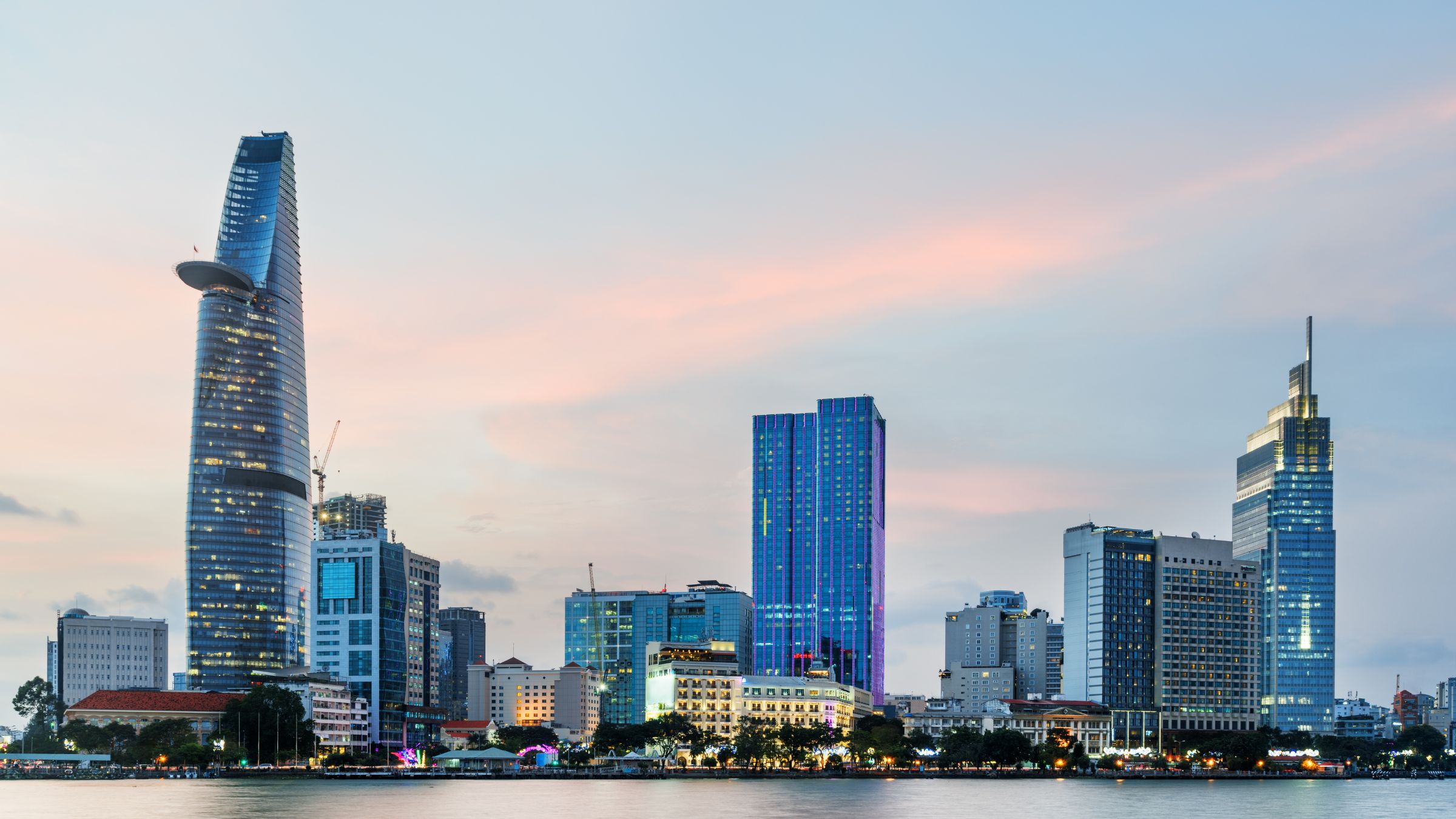
This is Saigon’s beating heart: the Notre-Dame Cathedral, the Central Post Office, Ben Thanh Market, Nguyen Hue walking street, and the Bitexco tower all within walking distance of each other. Your first morning here, you’ll step outside into a wall of warm air that smells like grilled pork, gasoline, and fresh coffee — and that’s when you’ll understand this city runs on sensory overload.
The soundtrack is constant: a million motorbikes humming like a swarm of mechanical bees, street vendors calling out, ice clinking in glasses of cà phê sữa đá at sidewalk stalls.
Stay near Ben Thanh or the Nguyen Hue end. Avoid booking right on Bui Vien — that’s the backpacker party street, and unless you plan to be part of the party until 3am, you don’t want to sleep above it.
Budget: hostels from $8–12/night, decent 3-star hotels around $35–50 (900,000–1,250,000 VND), and rooftop-pool territory starts around $80.
Best for: first-timers, short stays, and anyone who wants to walk everywhere.
🌳 DISTRICT 3 — WHERE SAIGON EXHALES
Cross an invisible line from District 1 into District 3 and the volume drops by half.
Suddenly there are tamarind trees arching over the streets, old French villas hiding behind mossy walls, and cafes where the only sound is a ceiling fan and the hiss of a phin filter dripping coffee. This is where Saigon’s office workers escape for lunch, and where the city’s best-looking cafes quietly live.
You’re near Turtle Lake (Hồ Con Rùa) — which at night turns into an open-air snack party where students sit on the steps eating bánh tráng trộn — and Tan Dinh, the pink church your camera roll is waiting for.
The center is still 5–10 minutes away by Grab bike (about 20,000–30,000 VND, or $0.80–$1.20). You give up almost nothing and gain actual sleep.
Budget: boutique hotels and minihotels from $25–40/night (625,000–1,000,000 VND). Better value than District 1, prettier buildings too.
Best for: couples, cafe people, and anyone whose idea of a good evening involves hearing themselves think.
🌉 DISTRICT 4 — THE STREET FOOD DISTRICT HIDING IN PLAIN SIGHT
District 4 is separated from District 1 by a thin canal and about 70% of the price.
For decades this was Saigon’s rough-around-the-edges port district. Now it’s the city’s worst-kept secret: five minutes from downtown over the Ong Lanh bridge, full of river-view apartments, and home to Vinh Khanh street — arguably the best seafood street in the entire city.
Come 6pm, Vinh Khanh turns into a carnival of charcoal smoke and clattering shells. Grilled scallops with scallion oil, snails in coconut milk, crab claws the size of your fist — all eaten on plastic stools while the street roars around you. Dinner with beer runs about 200,000–300,000 VND ($8–12) and you will not regret a single dong.
Budget: homestays and serviced apartments from $18–30/night (450,000–750,000 VND), many with legit river views.
Best for: food-obsessed travelers and anyone who wants downtown access without downtown prices.
🏮 DISTRICT 5 — CHOLON, THE CITY WITHIN THE CITY
District 5 is Cholon — Saigon’s Chinatown, and one of the oldest Chinese quarters in Southeast Asia.
This is a different Saigon entirely. Incense smoke curls out of the Thien Hau Temple, where the air tastes faintly of sandalwood and centuries. Binh Tay Market rumbles with wholesale chaos. And the food — dim sum at dawn, roast duck hanging in glass cases, noodle soups perfected over four generations — is some of the cheapest and most soulful eating in the city.
Be honest with yourself, though: you’re 20–30 minutes from the District 1 sights, and English is thinner on the ground here. This is a stay for travelers who want texture, not convenience.
Budget: hotels from $15–25/night (375,000–625,000 VND). Your money goes far here.
Best for: culture-divers, photographers, and second-time visitors who’ve already done the postcard stuff.
🌆 BINH THANH — WHERE THE BUDGET TRAVELERS ARE QUIETLY WINNING
Binh Thanh doesn’t make the glossy guides, which is exactly why the smart money stays here.
It sits just north of District 1, crowned by Landmark 81 — Vietnam’s tallest building — and packed with modern serviced apartments at prices that make District 1 hotels look like a prank. Many come with pools and skyline views for the cost of a windowless downtown room.
The neighborhood feel is real Saigon: morning markets like Ba Chieu where ladies in conical hats sell herbs before sunrise, alleys full of hủ tiếu carts, kids playing football between parked motorbikes.
Downtown is 10–15 minutes by Grab. The trade-off is you’ll ride rather than walk everywhere — but in this heat, you were going to do that anyway.
Budget: serviced apartments and homestays from $15–28/night (375,000–700,000 VND).
Best for: young travelers, groups splitting an apartment, and longer stays.
🧭 THE CHEAT SHEET
First time in Saigon, 2–4 days: District 1, near Ben Thanh. Just do it.
Want sleep and beauty: District 3.
Here mainly to eat: District 4, and bring elastic pants.
Already did the postcard stuff: District 5.
Watching the budget or staying a week+: Binh Thanh.
💡 THREE BOOKING TIPS FROM SOMEONE WHO LIVES HERE
Check the Google Maps street view before you book. “5 minutes from Ben Thanh” sometimes means 5 minutes by motorbike, through traffic, in the rain.
Book 2–3 weeks ahead for December–February and around Tet (Lunar New Year) — the city fills up and prices jump.
“Hem” (alley) addresses are not a red flag. Some of the best-value minihotels in Saigon hide in alleys 20 meters off the main road — quieter, cheaper, and more charming than the street-front ones.
Once you’ve picked your base, dive into our full Ho Chi Minh City guide for what to actually do when you get here — and if the south is just one stop on a bigger route, our Hanoi guide covers the other end of the country (and the other end of the personality spectrum).
Saigon doesn’t do subtle first impressions. Pick your district, drop your bags, and let the city swallow you whole.