Ten kilometres. That is all that separates the traffic scream of Hanoi’s Old Quarter from a village where men still stack clay pots by hand the way their great-great-grandfathers did.
And yet ninety percent of visitors get Bat Trang wrong.
They arrive at noon on a Saturday, get dropped straight at the ceramic market, buy a mug shaped like a cat, take a photo at the spiral museum, and leave two hours later thinking they have “done” a 700-year-old craft village.
They have not. They have done a souvenir mall.
Here is how we, as people who grew up an hour from this place, actually spend a day in Bat Trang. 🏺
FIRST, WHAT BAT TRANG ACTUALLY IS
Bat Trang sits on the left bank of the Red River, on the eastern edge of Hanoi, in the flat delta country where the soil is white clay instead of brown mud.
The village has been firing ceramics since roughly the 14th century, in the handover years between the Tran and Le dynasties. Local legend says three scholars sent north on a diplomatic mission came home carrying Chinese glazing techniques, and taught them to the families of Bach Tho — “the white earth hamlet.” That hamlet became Bat Trang.
It boomed for three centuries. Court households ate off it. Then in the 18th and 19th centuries, foreign markets closed, kilns went cold, and families walked away from the trade.
It came back in the 1960s. It is still coming back. That tension — heritage that nearly died and knows it — is exactly what makes the place interesting.
GETTING THERE: TAKE BUS 47A, SERIOUSLY
Route 47A runs from Long Bien transfer station directly to the village gate. No changes, no walking maze at the end.
The fare is around 7,000 to 10,000 VND (roughly $0.30). The ride takes about 40 minutes and buses leave every 20 to 30 minutes from early morning until evening.
For that price, a Grab car costs about thirty times more. We are not going to pretend the bus is glamorous — the seats squeak, the aisle fills up, and you will be the only foreigner on board. That is the point.
If you ride a motorbike, cross at Chuong Duong bridge or Vinh Tuy bridge and follow the Long Bien – Xuan Quan road until you hit Giang Cao street. Parking at the village is 5,000 to 10,000 VND. Use Google Maps, because the last two turns are unmarked.
There are also small Red River boat trips that stop here. Lovely, slow, and honestly better as a photo experience than a transport plan. [internal link: /en/hanoi/]
DO NOT GO TO THE MARKET FIRST
Turn left instead. Walk into the old village.
The alleys narrow until two people cannot pass without turning sideways. The brick underfoot is uneven and worn shiny. Moss climbs the walls in green-black patches and the air smells of coal smoke, wet earth, and something faintly mineral — the smell of a kiln that has been running since breakfast.
You will hear the village before you see any of it: a wet slap of clay hitting a wheel, a radio playing cai luong from inside a courtyard, a scooter engine echoing off two walls a metre apart.
Look at the walls themselves. Many are studded with flat discs of coal, pressed by hand and stuck up to dry in the sun. They look like honeycomb. That is the fuel for the kilns, and it is one of the most photographed things in Bat Trang that nobody puts on a tour brochure.
VAN VAN ANCIENT HOUSE AND THE VILLAGE COMMUNAL HALL
Deep in those alleys is Van Van, a private old house holding a collection of more than 400 antique ceramic pieces. Wooden beams, a courtyard, a light well, the whole northern Vietnamese architecture vocabulary in one small building.
Entry is a token fee, usually around 20,000 VND ($0.75), and sometimes the owner simply waves you in. Take your shoes off. Do not touch the shelves.
The village dinh — the communal hall dedicated to the guardian spirit of Bat Trang — dates from the 18th century and sits facing the water. Go in the late afternoon when the light turns gold on the red lacquer and the old men are playing chess out front.
This is the part of Bat Trang most tourists never see, and it takes an extra forty minutes. Forty minutes.
THE CERAMIC MARKET: FUN, LOUD, AND NOT THE SOUL OF THE PLACE
Now go to the market. You have earned it.
Hundreds of stalls, packed floor to ceiling with bowls, teapots, incense burners, fat laughing Buddha figures and, yes, cat mugs. Crackle glaze, cobalt blue, celadon, the deep brown of old rice-wine jars.
Prices run from a few tens of thousands of dong for a small bowl up to several million for artist pieces. Prices here are flexible and the sellers are chatty — asking politely is normal and expected, and half the sellers will happily explain how the piece was fired if you show interest.
Our advice: buy the ugly-beautiful stuff. The slightly warped tea cup with the uneven glaze is handmade. The flawless matching set was pressed in a mould.
Bubble wrap is free at most stalls. Ask. Your suitcase will thank you.
THE SPIRAL MUSEUM: WORTH IT, WITH ONE CAVEAT
The Bat Trang Ceramic Museum, officially the Vietnamese Craft Village Essence Centre, is the swirling building you have seen on Instagram. Seven curved blocks stacked and twisted like clay rising on a spinning wheel.
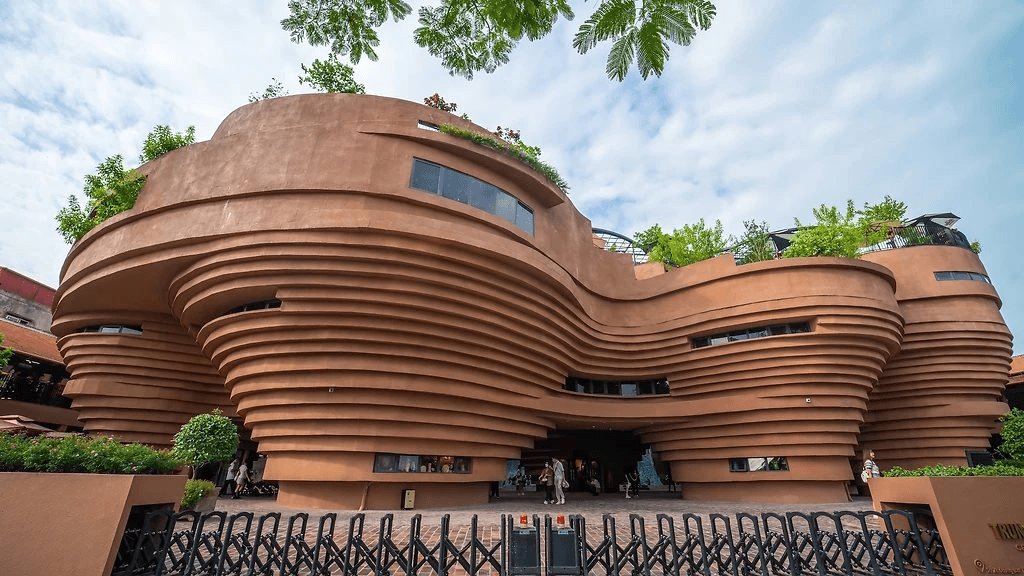
It was built by Ha Thi Vinh, the 15th generation of a Bat Trang pottery family, which matters — this is not an outside developer’s idea of heritage.
Ticket prices sit in the range of 30,000 to 200,000 VND ($1.15 to $7.60) depending on what you want. General admission to the exhibition floors runs around 60,000 VND, the ground-floor pottery workshop around 70,000 VND, and a combo covering everything is roughly 198,000 VND. Check on arrival, because the tiers change.
Upper floors hold the history displays, contemporary ceramic art, a restaurant, and a top-floor space for tea ceremony and traditional performances like chau van and quan ho.
The caveat: on weekends this building is a photoshoot. Bridal couples, influencers, school groups. Go on a weekday morning and you will have the curves and the light almost to yourself.
PUT YOUR HANDS IN THE CLAY
This is the bit people remember six months later.
Small workshops all over the village will sit you at a wheel for 40,000 to 80,000 VND ($1.50 to $3). You choose a shape — cup, bowl, small vase — and a woman who has done this ten thousand times will guide your hands.

The clay is cold and slick and it fights you. It will go lopsided. It will collapse entirely at least once and you will laugh out loud.
Then you paint it, and here is the practical part nobody warns you about: proper firing takes days. Most workshops will dry and finish your piece and let you collect it later, or ship it. If you are on a tight schedule, ask about this before you start, not after.
Come before 3pm. After that you are rushing.
EAT LIKE YOU LIVE HERE
Bat Trang food is northern delta cooking — restrained, savoury, not showy.
Look for canh mang muc, a dried bamboo and squid soup that is a genuine village specialty, traditionally cooked for Tet. It is the one dish here you will not easily find in central Hanoi.
Then there is banh te, a soft rice cake steamed in banana leaf, and banh day dau xanh with its mung bean centre. Both cost pocket change and both are better bought from a stand than a restaurant.
For a proper sit-down meal, bun rieu cua or bun cha at the small places near the market runs 30,000 to 70,000 VND ($1.15 to $2.70) a dish. Plastic stools, iced tea in a chipped glass, a fan pointed at your ankles.
Some ceramic shops also sell lotus tea and traditional candied fruit. Try before you buy — most will offer.
WHEN TO GO
Autumn, September to November, is the best window. Cool air, soft light, low humidity.
Spring, February to April, comes second — mild, but with the fine drizzle Hanoi calls mua phun that turns those brick alleys slippery.
Summer is brutal. The kilns radiate heat and the delta traps it. If you must go in June or July, be on the 8am bus and out by lunch.
And go on a weekday. Weekends bring Hanoi families and school field trips by the busload, which is charming for about eleven minutes.
OUR HONEST TAKE
Bat Trang is not a hidden gem. It is heavily visited, partly commercialised, and the market section is unapologetically a shopping destination.
But it is also a living working village where hundreds of families genuinely still make ceramics, where kilns fire every day, and where a fifteen-minute walk off the main street drops you into 18th-century Vietnam.
The difference between a mediocre Bat Trang trip and a great one is not money. It is direction. Turn left into the old alleys before you turn right into the market.
Half a day. Under 300,000 VND ($11) including transport, a workshop, lunch, and a bowl you made with your own hands.
That is still, in 2026, one of the best value days out anywhere near Hanoi. 🚌
So — are you the type who wants to spin the wheel and make something, or the type who just wants to wander the old alleys with a coffee? Tell us in the comments, because the answer changes which morning you should go. 👇