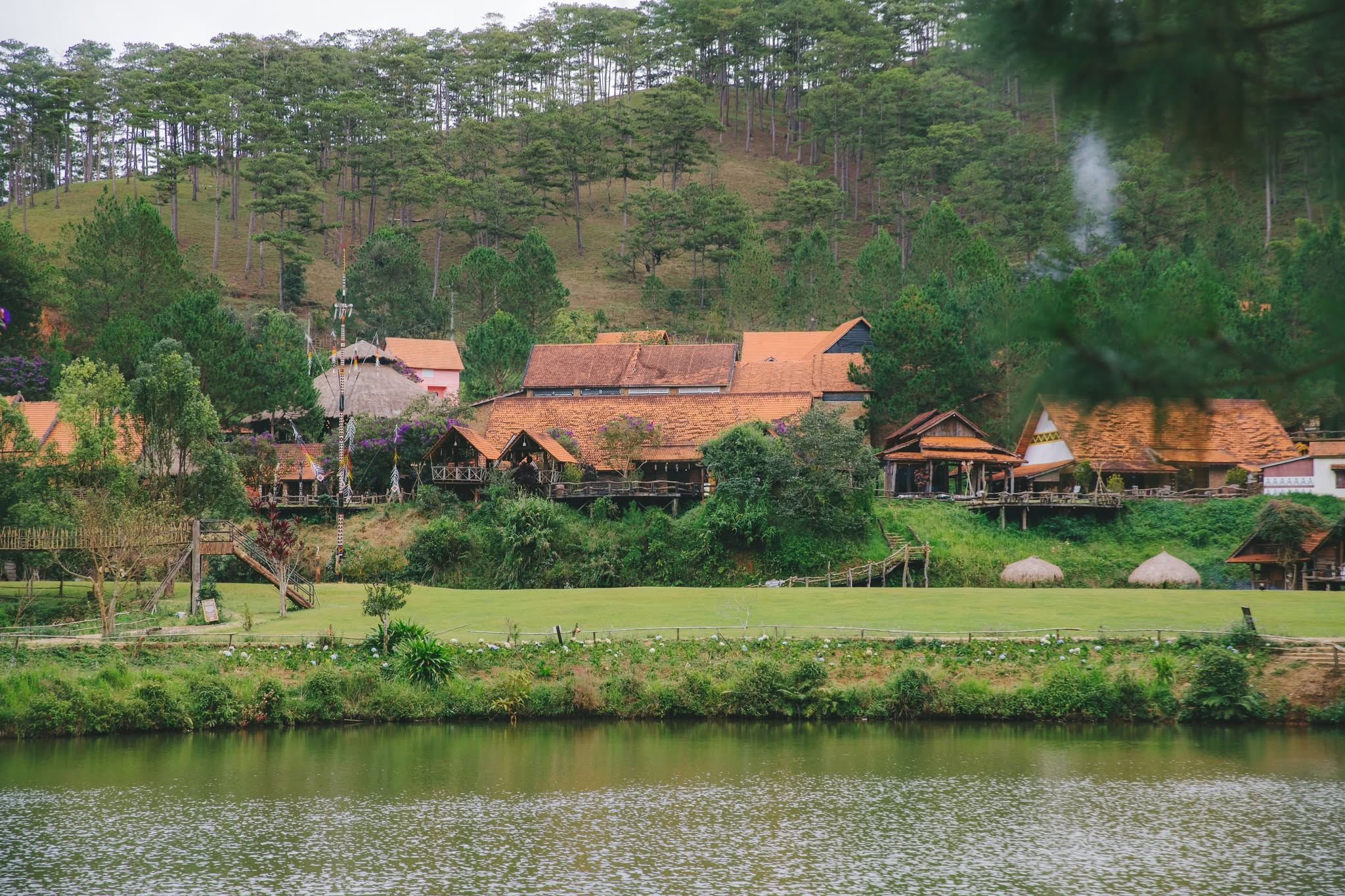
Cu Lan Village is a 30-hectare landscaped attraction in a pine valley about 20 km north of Da Lat, at the foot of Langbiang. It is often described online as an ancient K’Ho village. It is not one — it was built as a tourism site and opened to visitors in 2011. Go for the walk and the scenery, not for the cultural claims.
Quick facts
- Address: ĐT722, Lang Biang – Da Lat Ward, Lam Dong. Almost every website still lists the old address (Suoi Can hamlet, Lat commune, Lac Duong district) — those units were dissolved on 1 July 2025.
- Hours: 08:00–17:00 Monday to Thursday, 08:00–17:30 Friday to Sunday, per Google’s current listing. Several Vietnamese sites say 07:30 — assume the later opening.
- Entry: reported anywhere from 60,000₫ to 200,000₫ (~$2.30–$7.60). See below.
- Cards: unconfirmed for the ticket gate. Bring cash.
- English: staff are mostly from local ethnic minority communities; expect limited English and few explanatory signs.
- Getting around inside: all outdoors, on foot or by paid jeep. Steep in places and not wheelchair-friendly.
How much does it cost?
This is the part no Vietnamese travel article gets right, so read it carefully.
Published entry prices contradict each other completely. Vietnamese travel sites variously list 60,000₫, 100,000₫, 150,000₫ and 200,000₫ per person. One 2026 guide states the village’s own website shows 150,000₫; another says 150,000–200,000₫ including VAT. A recent visitor on Google reported paying 400,000₫ (~$15) for two people, which suggests the real figure sits at the higher end or includes a jeep.
The village’s official site (langculan.vn) would settle it, but it timed out repeatedly when I tried to load it. Call or message the village’s fanpage before you go, and budget 200,000₫ (~$7.60) a head so you aren’t caught out.
Other services, as listed by Vietnamese travel sites — all unverified against the operator:
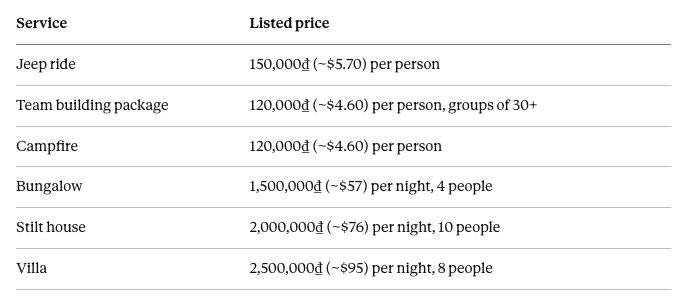
Children under 1 m are free. There is no child discount above that.
What’s actually there
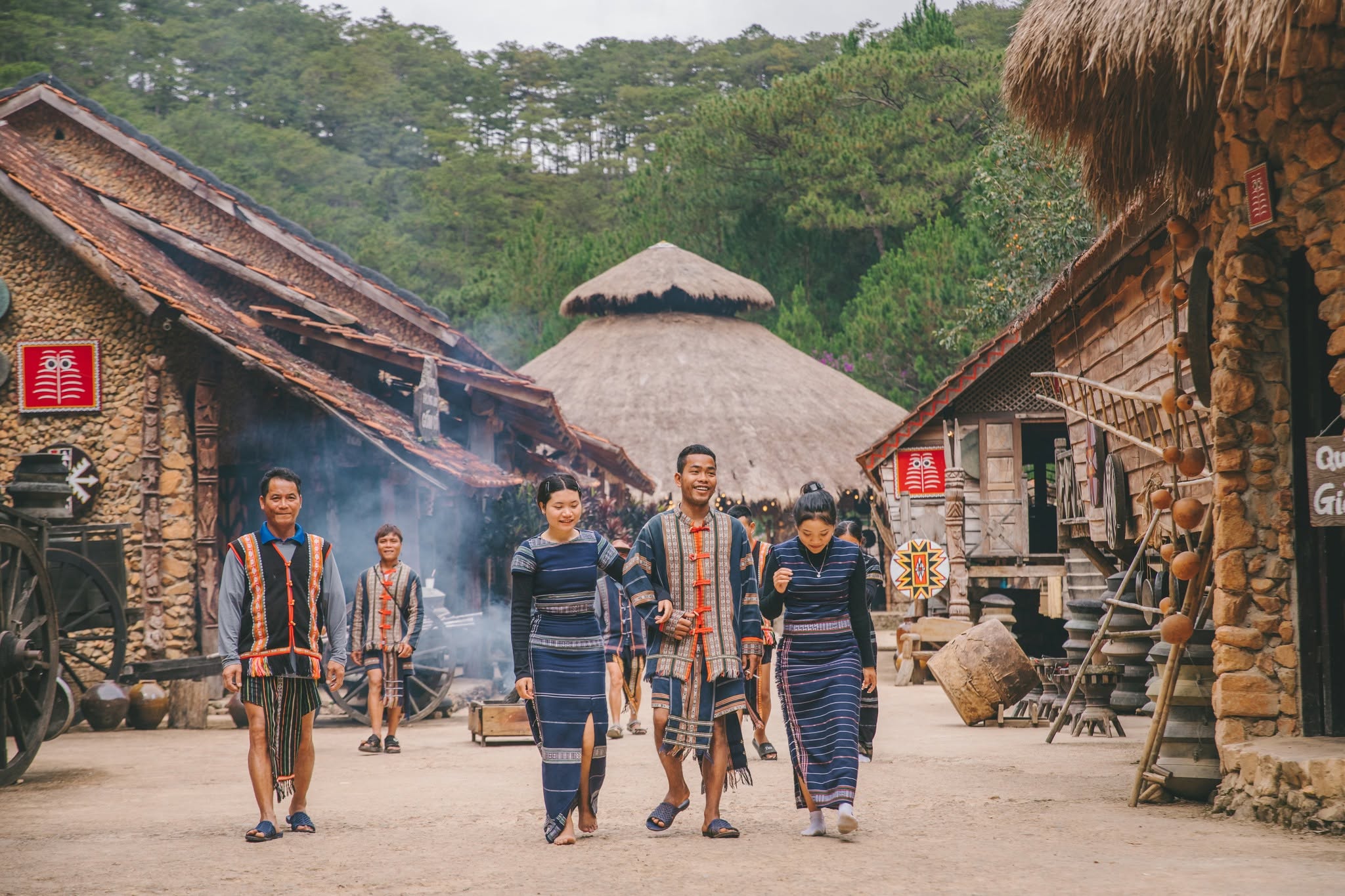
The site is divided into zones: a mock K’Ho hamlet, a small market called Chợ Chồm Hổm selling local produce and souvenirs, a camping area, restaurants, and a gallery.
The gallery is the one genuinely unusual thing here. Vietnam’s national tourism administration lists works by Nguyễn Tư Nghiêm, Nguyễn Trung, Đặng Xuân Hòa, Văn Dương Thành and Lê Thiết Cương among the paintings on display — serious names for a roadside attraction. Reaching the exhibition rooms means going up stairs on uneven paving.
Activities include archery, horse riding, bamboo rafting on the lake, traditional dress hire for photos, and jeep rides through the stream. Foreign visitors consistently report that staff are warm and go out of their way to pull people into the dances and games.
About that UNESCO claim
Nearly every article about Cu Lan Village — including the village’s own website — states that UNESCO recognised it as a cultural tourism destination. English-language tour sites repeat it word for word.
UNESCO does not issue that kind of designation to individual attractions. Cu Lan Village appears on no UNESCO list, including Vietnam’s tentative World Heritage list. The same goes for “one of the six most beautiful ancient villages in Vietnam,” which is cited everywhere and sourced nowhere.
The related claim that the village dates from the 1960s conflates two things: there was a small K’Ho settlement in the valley, but the attraction visitors pay to enter was built by investor Văn Tuấn Anh and opened in mid-2011.
None of this makes it a bad afternoon out. It does mean the cultural framing is marketing, and you should price your expectations accordingly.
Getting there
Roughly 20–22 km from central Da Lat, about 40 minutes by road. From Da Lat Market, the route runs via Trần Quốc Toản, Đinh Tiên Hoàng, Nguyễn Công Trứ, Xô Viết Nghệ Tĩnh and Ankroet, then about 10 km along the ĐT722. The road is sealed and easy for both cars and motorbikes.
A Grab out from the centre is possible but getting one back is unreliable at that distance — agree a return with your driver, or come as part of a day trip. It pairs naturally with [Langbiang Mountain](INTERNAL-LINK: Langbiang Mountain Da Lat), which is on the same road.
The downside
Two things, and the second matters more.
It is expensive for what it is, and remote. Multiple foreign reviewers use almost the same phrase: a pretty walk in an expensive park, a long way from town. If you have one afternoon in Da Lat, there are cheaper things closer in.
The reviews are solicited on site. More than one visitor reports staff asking them to scan a QR code and then watching while the review was submitted. That is worth knowing before you weigh up the 4.6 rating from 17,000+ Google reviews — and it lines up with the gap between that score and the 3.9 average across a much smaller set of Tripadvisor reviews. Read the written reviews rather than the number.
A third, smaller point: one long-standing complaint concerns the environmental positioning — petrol jeeps, generators and on-site rubbish burning sitting oddly alongside the eco branding. That report is old and unverified now, but it’s worth looking at with your own eyes.
Who it’s for
Good for families with children who need space to run, for groups doing team building, and for anyone who wants a couple of hours of forest walking with a coffee at the end.
Skip it if you’re short on time in Da Lat, if you’re travelling on a tight budget, if you use a wheelchair or have difficulty with steps and uneven ground, or if you came looking for a genuine ethnic minority village. For the last one, the honest answer is that this isn’t it.
Verdict
A well-kept, photogenic park that is straightforward about being pleasant and not at all straightforward about what it is. Worth a half-day if you have a car and a spare afternoon. Not worth restructuring a short Da Lat trip around.
Read next: plan a better Da Lat trip
- Top 10 Da Lat Attractions — Opening Hours & Ticket Prices (2026) — Use this before paying for another pretty-but-pricey park; it separates the real highlights from the photo-ticket traps.
- Da Lat Off the Beaten Path: 8 Hidden Gems Most Tourists Miss — If Cu Lan feels too staged, these quieter outskirts give you more pine air and fewer souvenir counters.
- Da Lat 3 Days 2 Nights: A Complete Itinerary for First-Timers (2026) — Slot Cu Lan into a realistic route without zigzagging across the highlands like a lost Grab driver.
FAQ
Is Cu Lan Village a real K’Ho village? No. It’s a purpose-built tourism site that opened in 2011, presenting K’Ho culture. Staff are largely from local minority communities, but the village itself is a construction.
How much is the entrance fee? Published figures range from 60,000₫ to 200,000₫ (~$2.30–$7.60) and no source is reliable. Confirm with the village directly before you travel.
How long do you need there? Two to three hours covers the walking loop, the gallery and a coffee. Longer if you’re doing activities or eating a full meal.
Can you stay overnight? Yes — bungalows, stilt houses, villas and camping. Listed prices start around 1,500,000₫ (~$57) a night for four.
Is it good in the rainy season? It’s entirely outdoors, on unpaved and uneven ground in places. Between roughly May and October, check the forecast first.