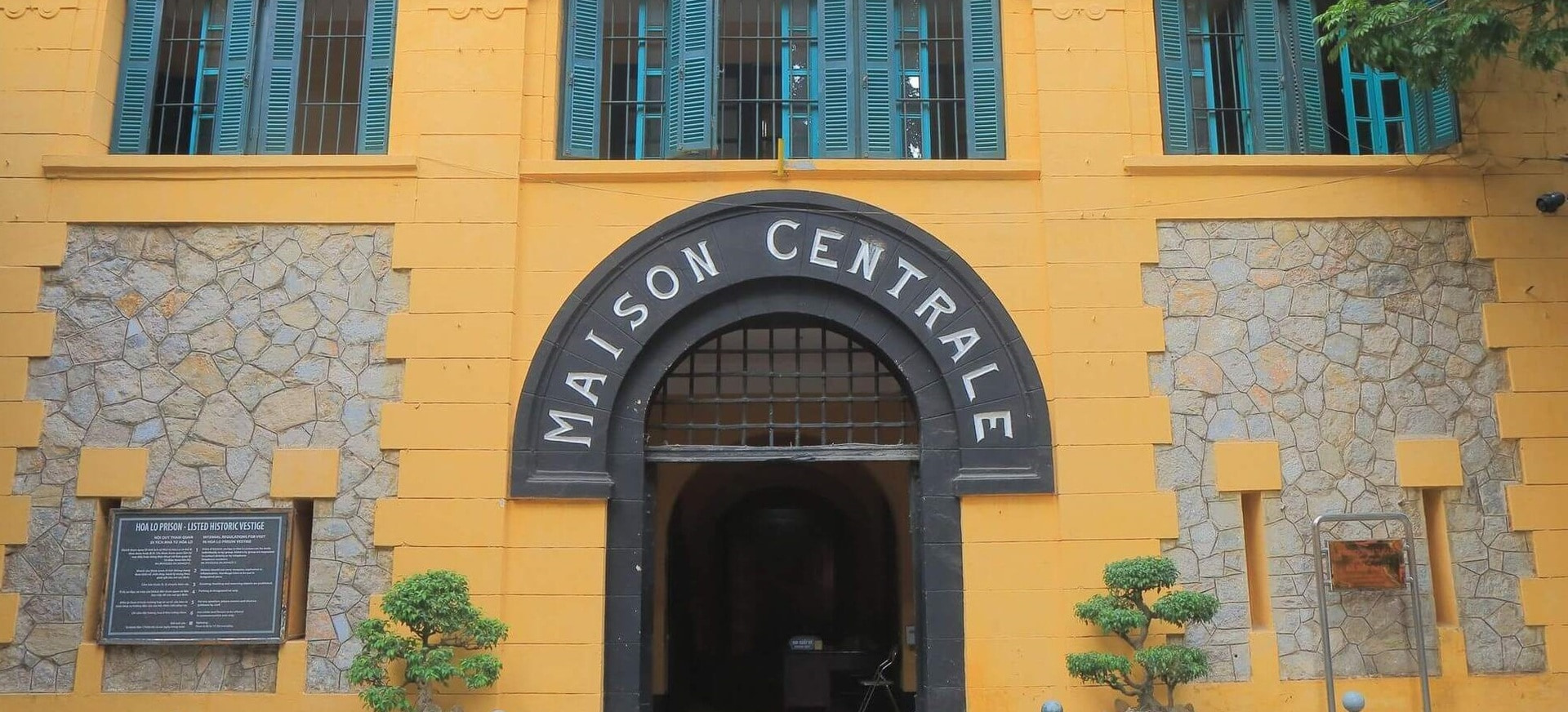
Hoa Lo Prison is a 50,000₫ (~$1.90) museum in central Hanoi, open 08:00 to 17:00 every day of the year, and it takes most people about two hours. It’s the site the French built in 1896 as Maison Centrale, the same building American pilots later called the “Hanoi Hilton”, and it’s one of the few Hanoi attractions where the low ticket price isn’t a warning sign.
One thing to know before you go: the entrance moved on 6 April 2026. More on that below, because it catches people out and the old signage online hasn’t caught up.
The new entrance (changed April 2026)
After roughly five months of restoration work, the relic changed its visitor route on 6 April 2026.
Entry is now through the side gate on the Hỏa Lò street pavement, to the right of the old main gate.
Exit is through the side gate opposite number 60 Thợ Nhuộm street.
The exhibits, objects and content are unchanged — only the route through them. Staff have been posted at the entrance and additional signs added, so it’s hard to get badly lost, but almost every guidebook and blog post online still shows the old main gate, and a fair number of visitors stand in front of it wondering why it’s shut.
Tickets, hours and address
| | | | Address | 1 Hỏa Lò street, Cửa Nam ward, Hanoi | | Hours | 08:00–17:00, every day including Tết and public holidays, no midday closing | | Ticket | 50,000₫ (~$1.90) | | Free | Under-16s (or under 1.3m if no ID), people with especially severe disabilities | | Half price | Students 16+ with ID, Vietnamese citizens 60+, people with severe disabilities, social policy categories | | Motorbike parking | Free, outside the gate |
A note on the address: the official site now lists the ward as Cửa Nam. Google Maps, most travel sites and probably your hotel’s printed map still say Trần Hưng Đạo ward, Hoàn Kiếm district. It’s the same building — Hanoi’s wards were redrawn in the 2025 administrative reorganisation.
You don’t need to book a daytime ticket. Buy at the desk and walk in, even at weekends. Guided tours in a group do need arranging ahead.
What Hoa Lo actually is
The French built the prison in 1896 on the land of Phụ Khánh village, a pottery-making community that was cleared to make room for it. It became one of the largest prisons the French operated in Indochina, and it was built specifically to hold Vietnamese political prisoners as the independence movements grew.
The list of people held here is a good part of why Vietnamese visitors come. Phan Bội Châu, Lương Văn Can, Nguyễn Quyền, Hồ Tùng Mậu and Nguyễn Lương Bằng were all imprisoned at Hoa Lo, as were five men who later became General Secretary of the Communist Party — Nguyễn Văn Cừ, Trường Chinh, Lê Duẩn, Nguyễn Văn Linh and Đỗ Mười.
Between 5 August 1964 and 31 March 1973 the prison held American pilots shot down over North Vietnam. That’s the chapter most Western visitors arrive knowing about, and it occupies a small part of the site — worth calibrating expectations for, because the museum is overwhelmingly about the French colonial period.
In 1993 most of the complex was demolished for a commercial development. The southeastern corner was kept, restored, and listed as a historical relic. That’s what you visit today: a fragment, not the whole prison.
What to see inside
The guillotine
The single object most people remember. The frame stands close to four metres, with a grooved track for the angled steel blade; the falling force is roughly equivalent to 60kg. Condemned prisoners were laid on a wooden bed with the head positioned through the opening.
It’s displayed plainly, without dramatisation, and it doesn’t need any.
The cachot
The dark cells — about 4m² each, walls painted black, no light and almost no air. Prisoners described it as being inside a grave.
The detail that lands is the floor: the concrete sleeping slab is built on a slope so that the head lies lower than the body, forcing blood to the brain. The cachot was reserved for people who had organised in the prison, spread revolutionary material, or attempted escape. Trường Chinh was held here after organising an International Workers’ Day gathering inside the walls.
If you take one thing slowly, take this room.
The bàng tree
There’s an Indian almond tree in the courtyard, and it carries more weight than a tree normally would. Former prisoners have said the original ones came from seedlings collected during forced labour outside the courthouse and planted in the yard sometime before 1930.
Prisoners used the leaves and fruit medicinally, the branches for chopsticks and flutes. The base of the tree functioned as a meeting point and, in practice, a dead drop for passing messages and material between cell blocks.
The memorial
At the far end there’s a monument to the Vietnamese patriots and revolutionaries who died here. Incense and flowers are appropriate at the memorial house, and not elsewhere on the site.
The night tour
The night programme, “Đêm Thiêng Liêng” (roughly “Sacred Night”), runs after closing with actors, lighting and a sound design instead of placards. It’s the relic’s best-known product and it sells out consistently.
Three programmes rotate: “Sáng ngời tinh thần Việt” and “Sống như những đóa hoa” at 399,000₫ (~$15), and “Lửa thanh xuân” at 499,000₫ (~$19). Tea, jelly and cakes made from the bàng tree are served at the end.
Booking is the hard part. There’s no online checkout — you message the relic’s Facebook page or ring the hotline (0825 112 668 / 0822 446 116) and they hold a place. In 2026 the relic was telling enquirers that dates two months out were already full. Plan four to six weeks ahead as an absolute minimum.
Which programme runs on which night changes, and so does the length — confirm the date, the price and the running time when you message them, rather than trusting any schedule you find online.
We’ve written this up separately in [our full review of the Hoa Lo night tour](INTERNAL-LINK: Hoa Lo night tour review).
Two free ways to visit
Worth knowing, and almost nobody mentions them.
The relic runs an online exhibition space for people who can’t get to Hanoi, and it has put audio tours on Spotify and Apple Podcasts. The recorded narration is built around former political prisoners describing prison life, solidarity between inmates, and escape attempts in their own words.
Search for the relic on either platform and check the language of the episodes before you download — it’s a better use of the flight in than most Hanoi prep reading.
Getting there
Hoa Lo sits between the Old Quarter and the Văn Miếu area, which makes it easy to slot into a day.
On foot from Hoan Kiem Lake: about 20 minutes, along Lê Thái Tổ, across Bà Triệu, right onto Hai Bà Trưng, then left onto Hỏa Lò street. Pleasant from October to April. In June to August, take a Grab.
By Grab: a bike from the lake takes under ten minutes and costs very little. A car costs more and is slower in evening traffic.
Practical notes
Bring as little as possible. Bulky bags go in the lockers at the entrance, and nothing flammable comes in. There are umbrellas available to borrow and a weather board at the entrance — small things, but they’re a fair indication of how the place is run.
The site is largely open-air and unshaded between blocks. In the summer, come at opening or in the last hour before close; the middle of a Hanoi July afternoon in a stone courtyard is not the experience.
No smoking, keep your voice down, don’t move the objects. Most visitors manage this without being told, but the exhibits sit at eye level and unglassed in places.
The downside
It’s small. The preserved portion is a corner of the original prison, and if you’ve read a lot in advance you may finish in 75 minutes and feel slightly short-changed at how compressed it is.
It’s photographs and text panels more than objects. Several recent visitors have made the same criticism — that the daytime museum reads more like a gallery of reproductions than a place where things happened. The cachot and the guillotine are the exceptions, and they’re the reason the visit works.
The framing is one-sided, and openly so. The section on the American pilots presents their captivity as comfortable, which is not how the men themselves described it. Read it as one country’s account of its own history — which is what every national war museum is — rather than as a neutral one.
Check ahead if step-free access matters. The visitor route changed in April 2026, and the relic is the best source on what the new route involves.
What to pair it with
Everything nearby is walkable or a short ride:
- St Joseph’s Cathedral — 850m
- Hoan Kiem Lake — 1.1km
- Văn Miếu (Temple of Literature) — 1.3km
- Trấn Quốc Pagoda — 4.4km
A workable half-day: Hoa Lo at opening, walk to the cathedral for coffee, then Văn Miếu in the late morning. See [our Hanoi Old Quarter guide](INTERNAL-LINK: Hanoi Old Quarter guide) for where to eat between them.
Is it worth it?
Yes, and it’s among the best value in Hanoi at 50,000₫. Give it two hours, go early or late in summer, and spend the time in the cachot rather than photographing the corridors.
Skip it if you’re travelling with young children — the guillotine and the torture material are not softened — or if you’ve got one day in Hanoi and no particular interest in the colonial period.
FAQ
How much is a ticket to Hoa Lo Prison? 50,000₫ (~$1.90). Free for under-16s, half price for students, over-60s with Vietnamese citizenship, and several other categories.
What are the opening hours? 08:00 to 17:00, seven days a week, including Tết and public holidays. There’s no midday break.
Do I need to book ahead? Not for the daytime visit — buy at the desk. The night tour is a different matter and needs four to six weeks’ notice.
Where is the entrance now? Since 6 April 2026, entry is through the side gate on the Hỏa Lò street pavement, right of the old main gate. You exit opposite 60 Thợ Nhuộm street.
How long does a visit take? About two hours, less if you skip the audioguide.
Is there an audioguide? Yes, available at the ticket desk. Ask about languages and the price when you buy your ticket.