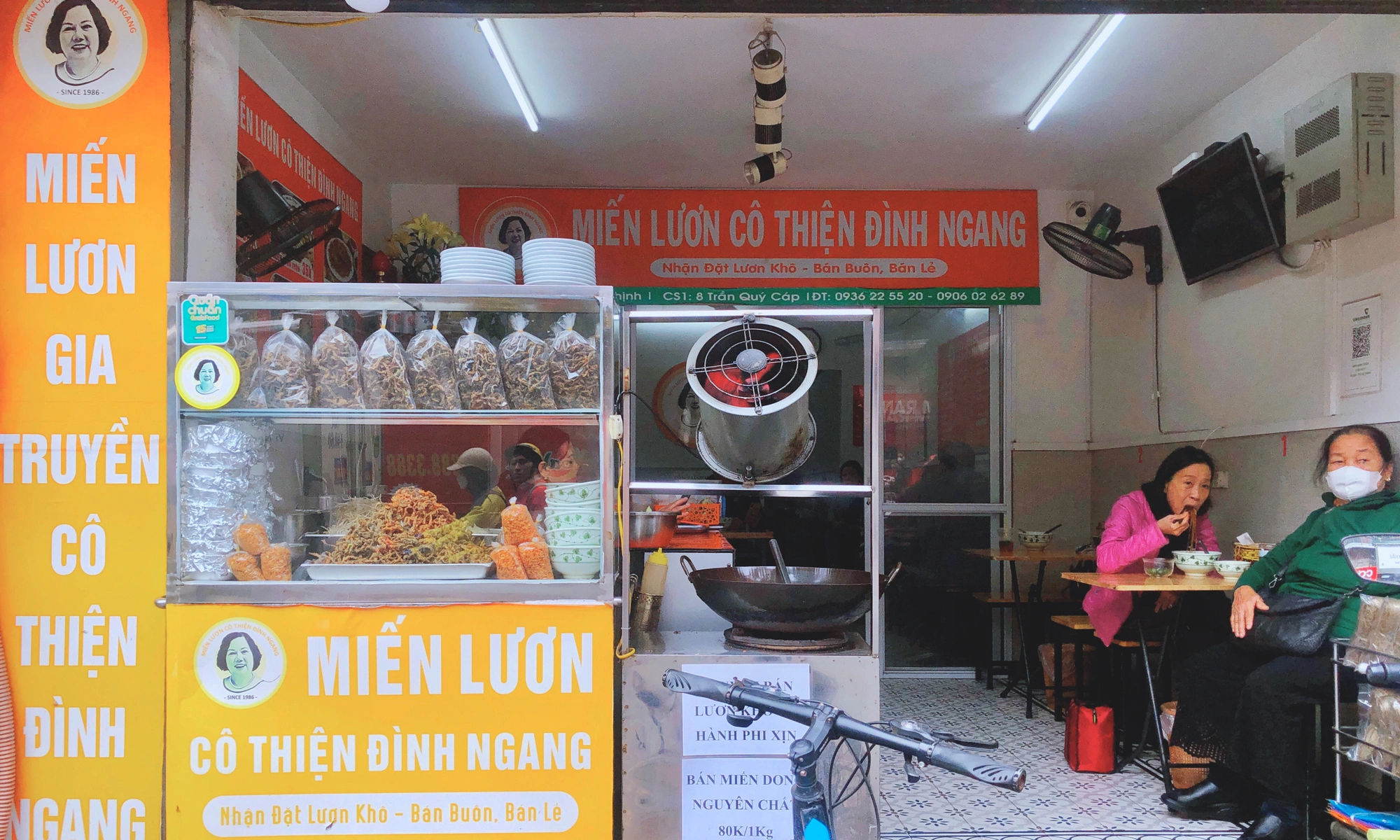
Miến Lươn Cô Thiện is a family-run shop selling glass noodles with fried field eel, working from a recipe that has passed through four generations of the same Hanoi family. The first shop opened in 1986; there are now two branches, one near the Temple of Literature and one further southwest on Thái Thịnh. A standard bowl is 45,000₫ (about US$1.70). It is a good place to try miến lươn if you have never had it — but the two branches are not interchangeable, and the menu has a portion system that catches people out.
Quick facts
- Trần Quý Cáp branch (CS1): 8 Trần Quý Cáp, Văn Miếu – Quốc Tử Giám ward, Hanoi. Tel 0906 026 289. Listed hours 7:00–19:30 daily.
- Thái Thịnh branch (CS2): 104-A49 Thái Thịnh, Đống Đa ward, Hanoi. Tel 0936 225 520. Listed hours 7:00–14:00 and 16:00–21:00, with a genuine afternoon closing — turning up at 15:00 means a locked door.
- Noodles 45,000–95,000₫, eel salad 95,000–120,000₫, drinks 5,000–25,000₫ (roughly US$0.20–4.60).
- Cash is the safe assumption. Delivery apps carry both branches.
- The price board is in Vietnamese only, though the dish photos are labelled in English. Staff English is limited.
- Indoor seating with fans and air-con; both rooms are small.
Note that Hanoi dropped the district level in the July 2025 administrative reorganisation, so older listings say “Đống Đa district” and “Hoàn Kiếm” for these addresses. The streets have not moved. Navigate by the map pin rather than the written address.
Four generations of one recipe
The dish is the family’s own. The owner, Ninh Hồng Thiện, learned it from her mother, who learned it from her mother — both of whom sold it from shoulder-pole baskets rather than a shopfront. She opened the family’s first fixed premises at 14 Đình Ngang in 1986, moved the business to Trần Quý Cáp in 2010, and in 2021 handed that shop to her child and began cooking at the Thái Thịnh location herself.
That history is the reason the two branches share a name and a recipe but not a kitchen, and it is worth knowing before you choose one.
What goes into a bowl
The eel is bought fresh from Nghệ An province — small, smooth-skinned, evenly round. It is cleaned with coarse salt and rice-washing water to strip the slime and the muddy smell, then steamed with rice wine and bruised ginger so the flesh comes off the bone cleanly. The meat is cut into short lengths, coated in a house blend of flours and seasonings, and fried until firm. Turmeric in the coating gives it the dark gold colour.
The broth is simmered four to five hours from pork bones and eel bones. Many shops crush the eel bones to squeeze more flavour into the pot, which makes the broth stronger but cloudy and full of sediment; this kitchen leaves them whole, trading some depth for a clear, lightly sweet broth. That choice explains the most common complaint about the soup version, and also the most common compliment.
A bowl is assembled fast, because the eel is already fried: glass noodles made from canna starch and bean sprouts are blanched in the hot broth, then topped with onion, Vietnamese coriander, sawtooth herb, fried shallots and the eel, and the broth goes over the top. Kumquat, garlic vinegar and chilli oil are on the table.
How the portions work
This is the part worth reading before you order, because the menu prices four sizes of the same dish and the difference is entirely the eel:
- Suất thường — standard. Crisp eel or soft eel, one or the other.
- Suất thêm lươn — extra eel, or a mix of crisp and soft. Ten thousand đồng more.
- Suất đầy đủ — crisp eel, soft eel and eel cake together, or a double portion of eel.
- Suất đặc biệt — double portion of all three.
Crisp eel (lươn giòn) is the fried version most people picture; soft eel (lươn mềm) is steamed and stays tender in broth. Order suất thêm lươn the first time — it gets you both textures for 10,000₫, which is the single best-value decision on this menu. The standard portion is enough food, but it makes you pick a side.
What to order
The soup version (miến lươn nước) is the default order and the one the kitchen is built around, at 45,000₫ standard. The mixed version (trộn) is the same price and comes with a garlic, sugar, vinegar, chilli, pepper and fish sauce dressing plus pickles instead of broth. It is the better choice in hot weather, and it shows off the crisp eel, which softens in soup.
The stir-fried version (xào) costs 10,000₫ more across every tier and is the one to skip. Recent diners have described it as heavy on oil and light on eel. Eel salad (nộm lươn) is 95,000₫ and is a shared starter rather than a meal. Fried dough sticks are 5,000₫ and are eaten alongside the soup the same way they are with phở; a poached egg is 7,000₫.
Both branches sell eel by weight to take home — 100g of dried eel is 140,000₫, soft eel 100,000₫. Fried shallots are sold the same way at 35,000₫ per 100g, which is a better souvenir than it sounds.
How much does miến lươn cô thiện cost?
Prices below are from the menu board, checked in August 2026. Conversions are approximate at 26,000₫ to the dollar.
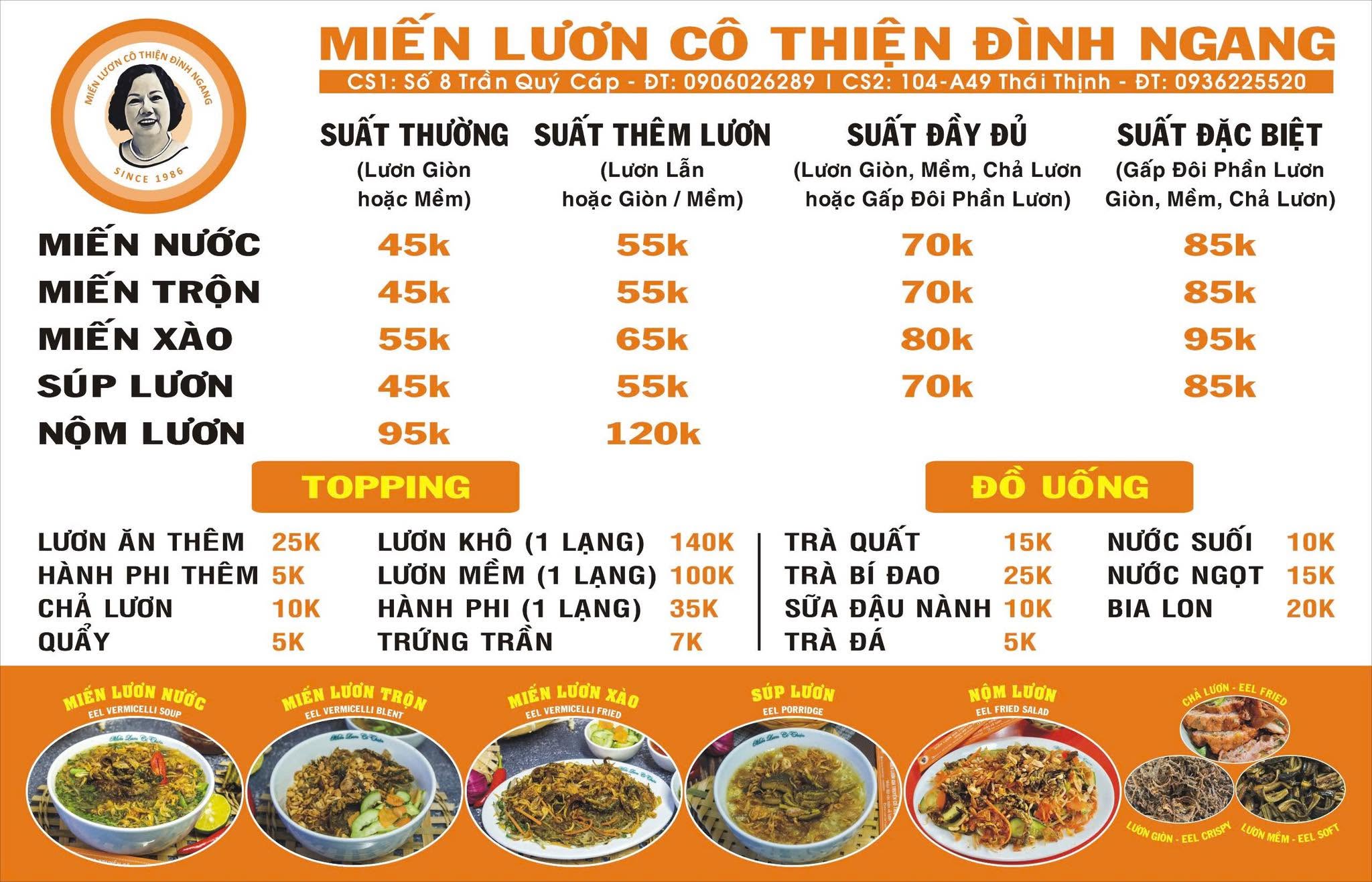
Extras: additional eel 25,000₫, eel cake 10,000₫, extra fried shallots 5,000₫, fried dough sticks 5,000₫, poached egg 7,000₫.
Drinks are cheap and worth knowing about in Hanoi heat: iced tea 5,000₫, soya milk 10,000₫, bottled water 10,000₫, kumquat tea 15,000₫, soft drinks 15,000₫, canned beer 20,000₫, winter melon tea 25,000₫.
Two bowls with drinks comes to roughly 110,000₫ for two people (about US$4.20), which is inexpensive by central Hanoi standards. Note that most articles online still quote 35,000₫ a bowl — that figure is from 2023 and no longer applies.
Getting there
The Trần Quý Cáp branch is a little over a kilometre west of Hoàn Kiếm Lake, beside the Temple of Literature and close to Hanoi Railway Station, which makes it the practical choice for most visitors — it pairs naturally with a morning at the temple. The shopfront is narrow and easy to walk past.
The Thái Thịnh branch is about four kilometres southwest of the lake, in a residential stretch with no other reason to go there. It is where the original owner cooks, and locals who have followed her since Đình Ngang go for exactly that reason. A Grab bike is the cheapest way to reach either; motorbike parking is tight at both.
The downside
The Thái Thịnh room has got worse to sit in. Pavement seating is no longer permitted, so everyone is packed into an indoor space that recent reviewers describe as cramped, and its Google rating has slid to 3.7 from around 48 reviews — noticeably below the 4.2 at Trần Quý Cáp. Lunch (roughly 12:00–13:30) and dinner (19:00–20:30) are the crush hours at both branches, and the wait during them is the most common local complaint.
The broth divides people. Several diners find it mild to the point of being underseasoned, which is the direct consequence of that clear-broth decision. If you like a heavy, assertive noodle soup, this is not that, and the mixed version will suit you better.
Who it’s for
Good for a first go at miến lươn, for anyone already visiting the Temple of Literature, and for travellers who want a long-running family shop rather than a place built for tourists. Reasonable for solo diners — the counter turnover is fast.
Skip it if you need an English menu and hand-holding, if you are travelling with a group larger than four, or if you want to linger; neither room has the space for it.
Verdict
Worth the detour if you are already in the Văn Miếu area, and worth a deliberate trip only if you care about eating the version cooked by the woman who has made it since 1986 — in which case go to Thái Thịnh, and check the afternoon closing before you set out. Go before noon at either branch, and order suất thêm lươn.