Here is a number that should annoy you if you visited Saigon last week and spent your days sweating inside a Grab car: 40,000 VND.
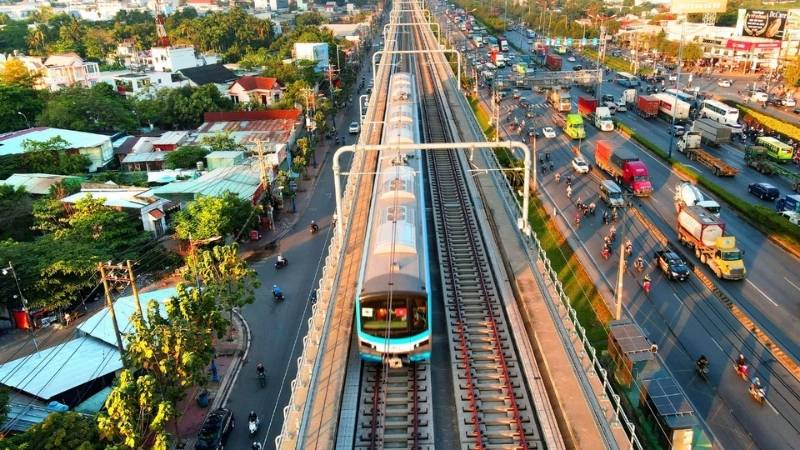
That is about $1.50. That is one unlimited day on Ho Chi Minh City’s Metro Line 1 — 14 stations, nearly 20 kilometres, air conditioning so cold you will want a jacket, and a moving window seat over one of the fastest-changing skylines in Southeast Asia.
Most international visitors still don’t use it. They land, they open Grab, they sit in traffic on Xa Lộ Hà Nội for fifty minutes, and they never look up at the elevated track running directly above them.
Don’t be that tourist. 🚇
🚇 WHAT SAIGON QUIETLY BUILT WHILE YOU WEREN’T LOOKING
Metro Line 1 — Bến Thành to Suối Tiên — opened on 22 December 2024, roughly twelve years later than originally promised. For most of that time it was a running joke in this city. Torn-up roads, missed deadlines, a whole generation of Saigonese who assumed they’d be retired before a train ever ran.
Then it ran.
The line covers 19.7 kilometres and 14 stations. The first three — Bến Thành, Opera House and Ba Son — are underground, Vietnam’s first subway tunnels. The other eleven are elevated, which is the entire point for a traveller. You emerge from the tunnel just after Ba Son and spend the next eleven stops gliding two storeys above the city.
It was funded mostly by Japanese development loans and built with Hitachi trains, which explains why the whole thing feels less like a Vietnamese public works project and less like Tokyo than something in between: silent, clean, cold, and full of people quietly staring at their phones.
In its first year it carried more than 19 million passengers, averaging around 52,000 riders a day — comfortably ahead of what planners expected. Line 2 broke ground in January 2026. Realistically you’re looking at 2030 before it opens. So for now, Line 1 is the metro.
The smell inside a carriage, by the way, is nothing. No exhaust, no fish sauce, no hot asphalt. In Saigon that absence is itself a sensation.
💸 THE TICKET MATH THAT MAKES THIS ABSURD
Single rides are distance-based:
- 🎫 Cash: 7,000 – 20,000 VND (about $0.27 – $0.77)
- 🎫 Cashless: 6,000 – 19,000 VND (about $0.23 – $0.73)
- 🎫 1-day pass: 40,000 VND (about $1.50) — unlimited
- 🎫 3-day pass: 90,000 VND (about $3.45) — unlimited
- 🎫 Monthly pass: 300,000 VND (about $11.50)
Sit with that for a second. A short hop between central stations costs less than half a bánh mì. A ride from the market to Thảo Điền costs less than a cà phê sữa đá, which runs around 30,000 VND at a decent street stall these days.
And the day pass is where the real trick is. It runs for 24 hours from your first tap — not from midnight, not from the calendar date. Tap in at 4pm on Tuesday and you’re covered until 4pm Wednesday. Two travel afternoons out of one $1.50 ticket.
For comparison: a Grab car from the centre out to Thảo Điền at rush hour will usually run you well past 100,000 VND, and it will take three times as long. The metro doesn’t beat Grab on comfort. It obliterates it on value.
🎫 HOW TO ACTUALLY BUY A TICKET WITHOUT LOSING YOUR MIND
This is the part where we stop cheerleading and get useful, because ticketing is genuinely the weakest link in the whole system.
Every station runs two completely different kinds of ticket machine, and nothing obvious tells you which is which.
The shorter, more conventional-looking machines are cash only. They accept notes up to 100,000 VND. They do not accept 200,000 or 500,000 VND notes — the exact notes an ATM here loves to give tourists. They also dislike crumpled money, so smooth your bills first. Depending on the fare, these machines issue a plastic card with a small refundable deposit that you return after your trip.
The taller white machines take international cards and domestic e-wallets (MoMo, ZaloPay, ShopeePay) and print a paper ticket with a QR code. The scanner for that QR sits on the underside of the gate unit, which is not where anyone looks first. Don’t fold the ticket. A creased QR code and a growing queue behind you is a specific kind of Saigon stress.
Three things that make all of this easier:
✅ Just tap your contactless card. Visa, Mastercard and NAPAS work directly at the gates. Tap in, tap out, fare calculated automatically, no machine, no ticket. This only works for single journeys — not day passes — and the metro does a poor job of advertising it. It is by far the fastest option for a one-off ride.
✅ Download the HCMC Metro HURC app for day and multi-day passes. It’s on iOS and Android, takes foreign cards, and stores your ticket as a QR code on your phone. A phone screen cannot be crumpled. The app does flip between English and Vietnamese at unhelpful moments, so screenshot your ticket screen once you have it.
✅ Ask staff. Every station is properly staffed and the guards are used to helping baffled visitors at the machines. This is not something to feel awkward about — you will not be the first person that hour.
🗺️ THE 14 STATIONS, AND WHETHER YOU SHOULD ACTUALLY GET OFF
Running west to east. We’re being honest about which stops earn a walk and which are just scenery.
GET OFF HERE
[L1-01] Bến Thành — The line’s spine and the future interchange for every planned metro line in the city. Bến Thành Market is right there, Bùi Viện backpacker street is a short walk west, and the Fine Arts Museum sits a few blocks away in a mansion most people walk straight past. The station’s underground concourse is enormous and half-empty, which feels strange now and won’t in five years.
[L1-02] Opera House — Possibly the single most useful stop for first-time visitors. You surface into the French colonial core: the Opera House itself, Nguyễn Huệ Walking Street, the Cafe Apartment, Notre-Dame Cathedral and the Central Post Office all within an easy stroll. One exit dumps you inside a luxury mall, which is a mildly humbling experience in shorts and sandals.
[L1-03] Ba Son — The old French shipyard is gone, replaced by towers and the sweeping Ba Son Bridge. What’s here now is riverfront. The Saigon River promenade is wide, breezy, and gives you the skyline from water level. Still partly under construction, but worth ten minutes of leg-stretching.
[L1-04] Văn Thánh Park — The first elevated station, and the moment the ride gets good. Văn Thánh Park sits directly below the tracks — a pond, shade, and one of the better public swimming pools in the city nearby. Late afternoon is the time.
[L1-05] Tân Cảng — Landmark 81, Vietnam’s tallest building, and Vinhomes Central Park. Fair warning: neither station connects to Vinhomes by a proper pedestrian bridge, so you’ll be looping under overpasses and crossing live traffic. Văn Thánh Park is arguably the easier approach on foot.
[L1-06] Thảo Điền — Saigon’s international enclave, across the river. Cafés, riverside bars, art spaces, and some of the better mid-to-high-end dining in the city. It is not representative of Vietnam and everyone here knows it — go for the food and the breeze off the river, not for authenticity.
[L1-07] An Phú — Vincom Mega Mall is at the northern exit. The real reason to stop is Pháp Viện Minh Đăng Quang, a multi-storey Buddhist temple complex a short walk from the southern exit. Rising out of a landscape of malls and highway noise, it’s one of the more quietly striking things on the whole line.
[L1-11] Thủ Đức — Our sleeper pick. The area around Thủ Đức Market still has the rhythm of an older southern town: low shopfronts, informal stalls, no glass towers. If you’re not travelling deeper into the Mekong Delta on this trip, an hour wandering here gives you a real glimpse of everyday life. Note that Thủ Đức City itself was dissolved into Ho Chi Minh City in the 2025 administrative reforms, so the name means something different on paper now than it did on your old guidebook’s map.
[L1-13] National University — Student energy, cheap food, and directly opposite the entrance to Suối Tiên Theme Park. Suối Tiên is gloriously, unapologetically strange — giant folk-hero statues, dragons, water rides, none of it imitating Disney. Families with kids get the most out of it. Ticket structure is a maze of combos and changes seasonally, so check the official site the morning you go rather than trusting any blog price, including ours.
RIDE PAST
[L1-08] Rạch Chiếc, [L1-09] Phước Long, [L1-10] Bình Thái, [L1-12] Hi-Tech Park — Workshops, container yards, factory housing, residential commuter streets. Genuinely interesting to look at from the window; not much reward for a hot walk beside a highway. The view over the cargo yards at Phước Long is the best thing here, and you get it without leaving your seat.
[L1-14] Suối Tiên Terminal — Despite the name, this is not the stop for the theme park. It’s the stop for the New Eastern Bus Station (Bến Xe Miền Đông Mới), which makes it enormously useful if you’re catching a long-distance bus north to Đà Lạt or Nha Trang. Metro to bus terminal for 20,000 VND instead of an hour of highway taxi fare is one of the great practical wins of Line 1.
☀️ THE ONE-DAY METRO ROUTE WE’D ACTUALLY DO
Buy the 40,000 VND day pass. Then:
🌅 8:00 — Start at Bến Thành. Coffee and a bowl of something at the market side streets before the heat lands.
🏛️ 9:30 — One stop to Opera House. Notre-Dame, the Post Office, Book Street, Cafe Apartment. Walk it slowly.
🌊 11:30 — Ba Son. Riverfront breeze, skyline photos, then back underground before midday sun wins.
🍜 12:30 — Thảo Điền for lunch. This is the long, good stretch of elevated track — sit on the right heading east and watch the city change shape through the window.
🛕 14:30 — An Phú. The temple. Cool stone, gardens, and the metro threading between towers seen from the upper floors.
🏘️ 16:00 — Thủ Đức. Market wander, iced tea, actual daily life.
🌆 17:30 — Ride back west with the light going gold across the skyline. This is the best fifteen minutes of the day and it costs nothing extra.
Total transport spend: 40,000 VND. About the price of one bottled water at an airport.
⚠️ WHAT NOBODY TELLS YOU BEFORE YOU RIDE
🕔 Hours are shorter than you think. Trains start at 05:00 daily. Last service is 22:00 Monday to Thursday, and 23:00 Friday to Sunday. If you’re planning an evening in Thảo Điền, budget a Grab home.
🚕 The airport is not connected. Tân Sơn Nhất has no metro link. None. Don’t plan your departure around one.
🌃 Ride during daylight. After dark the carriage lights are so bright the windows turn into mirrors. The famous elevated view basically disappears. Night rides are for transport, day rides are for the view.
🚶 Walkability is the weak point. Several elevated stations drop you beside a highway with limited crossings and thin footpaths. Check on a map how you’ll actually reach your destination on foot before you commit to getting off.
⏱️ Trains run roughly every 10 minutes. Frequent enough not to plan around, slow enough that missing one costs you a real wait. Peak times — early morning and late afternoon — are properly full.
🚻 Every station has toilets, staff and elevators. The elevators can be hard to spot from the street, easier once you’re inside. Maps at the entrance show where they are.
💧 Bring a layer. We are not joking about the air conditioning.
💬 OUR HONEST TAKE AS LOCALS
Line 1 has not fixed Saigon’s traffic. It was never going to. One line through the eastern corridor of a city of nearly ten million is a start, not a solution. The ticketing is clumsy, the street-level signage is nearly invisible, and the walk from some stations to anything worth seeing involves negotiating a highway on foot.
And yet.
For a visitor with three or four days in Ho Chi Minh City, this is the best-value thing in the city and it isn’t close. Two dollars buys you a day of movement, a cold place to sit, and a moving vantage point on a city rebuilding itself in real time — new towers next to old temples, container yards next to luxury compounds, all of it sliding past at eye level with the third floor.
There’s also something worth noticing that has nothing to do with logistics. Riding Line 1 with a carriage full of students heading to National University and workers heading to Thủ Đức, you get a version of this city that no tour bus route will give you. Twelve years late, and people here are visibly, quietly proud of it.
Skip it and you’ve paid more, seen less, and spent your holiday looking at the back of someone’s helmet in traffic.
So: which stop are you getting off at first? Tell us — and if you find something good at Rạch Chiếc, we genuinely want to hear about it. 👇
Planning the rest of your Saigon days? Our full city guide is here— and if you’re heading north afterwards, start with Danang or Dalat
Prices and schedules verified August 2026. The metro updates its ticketing faster than most blogs update their posts, so treat fares as a guide and check the HCMC Metro HURC app for the current picture.