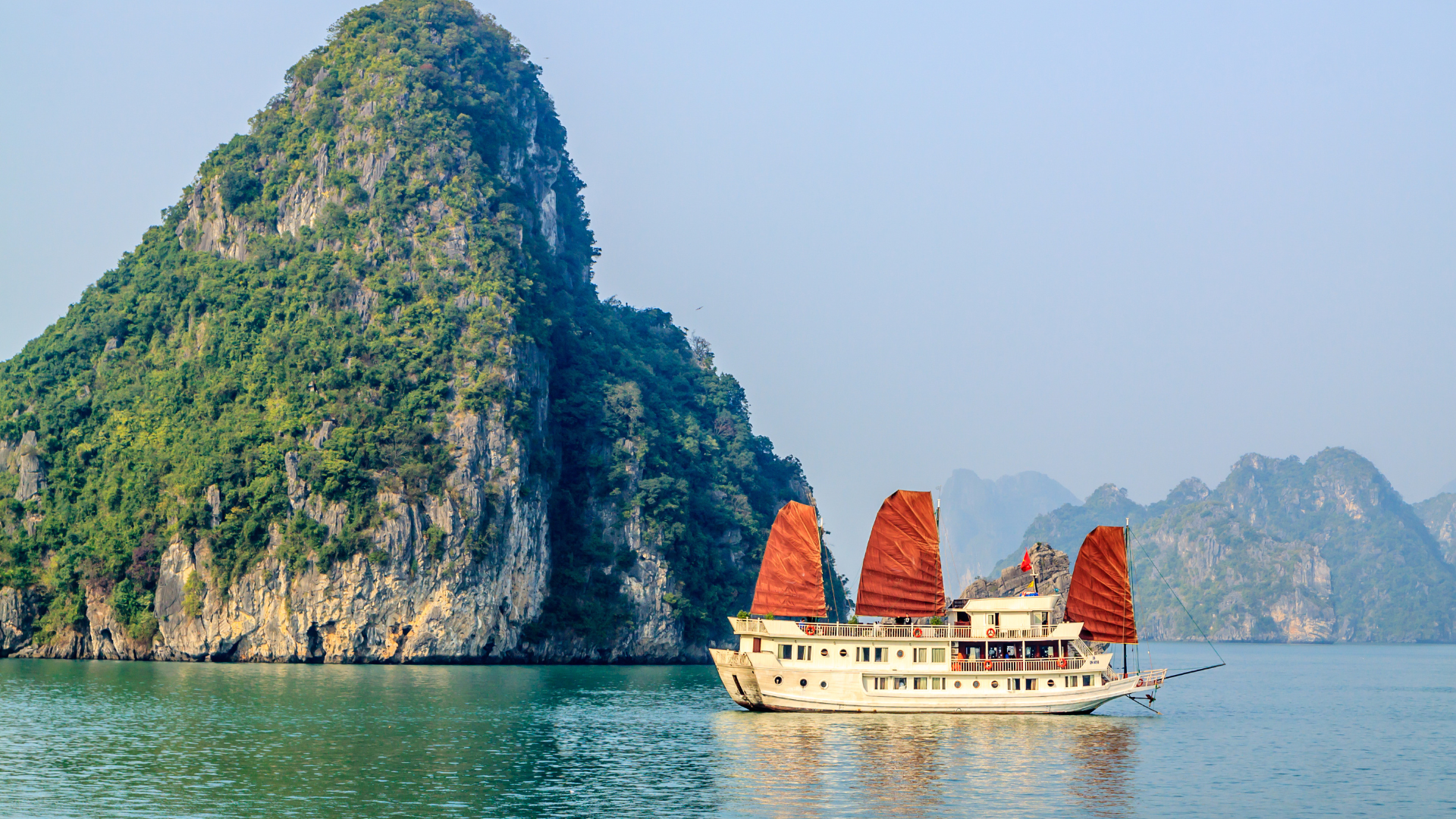
Here’s the question everyone asks: is the extra night worth roughly 150 more dollars?
And here’s why almost everyone answers it wrong: they think they’re buying 24 more hours.
You’re not. You’re buying one specific thing that happens on the morning of day two — and if your operator doesn’t do it properly, you’ve paid a premium to watch a luggage handover. 🛳️
Let’s break this down the way we’d explain it to a friend over coffee in the Old Quarter.
THE HOURS NOBODY COUNTS ⏰
Start with the actual clock, because the marketing names are misleading.
A 2D1N cruise is not two days. Boats board around midday and return to the pier late the following morning. That’s roughly 24 hours aboard, and about eight of them you’ll be asleep.
Pickup from Hanoi’s Old Quarter is usually somewhere between 7:45 and 8:30 in the morning. The road transfer runs about 2.5 hours to the central Ha Long ports, and closer to 3 to 3.5 hours if your boat sails from the Lan Ha or Bai Tu Long side.
So your real day one looks like this: a long minibus ride, a welcome drink, lunch while the boat pulls away from the pier, one afternoon activity, sunset on the top deck, dinner, and bed.
Day two is breakfast, maybe a short cave stop, then packing.
A 3D2N runs the same start and finish but adds a full middle day, landing at roughly 48 hours aboard.
Sit with that math for a second. You are paying somewhere in the region of double the price to go from about 16 waking hours on the water to about 32. That’s not a rip-off — but it’s a very different proposition from “one extra day.”
WHAT THE EXTRA MONEY ACTUALLY BUYS 🛶
The real product difference isn’t time. It’s the day boat.
On the morning of day two, 3D2N passengers transfer off the mother ship onto a smaller vessel. That day boat goes into water the big ship physically cannot enter — narrow channels, shallow lagoons, the coves behind the coves. Lunch is served on board, and you rejoin the main cruise somewhere around 3 to 4 in the afternoon.
That’s the whole thing. That’s what you’re paying for.
And it’s genuinely good. The parts of the bay that stay quiet are quiet precisely because forty-metre steel hulls can’t get to them. Kayaking through a lagoon where the only sound is your paddle and a hornbill somewhere in the limestone is a fundamentally different experience from kayaking in a cove with six other boats anchored around you.
Depending on route, that middle day might also include a floating fishing village reached by bamboo boat, cycling through Viet Hai village on Cat Ba Island, or a beach the day-trippers never see.
THE DAY 2 TRAP NOBODY WARNS YOU ABOUT ⚠️
Now the part that made us want to rewrite this whole guide.
If you don’t take the day boat excursion — because you skipped it, because it wasn’t included, or because weather cancelled it — here’s what happens instead.
Your ship sails back to the pier. It disembarks yesterday’s 2D1N passengers. It takes on a fresh group. Then it sails out again on essentially the same loop it did the day before.
You spend the middle of your three-day cruise watching suitcases move.
We’ve heard versions of this from travellers for years, and it’s the single biggest reason people finish a 3D2N feeling they overpaid. The cruise wasn’t bad. They just bought the longer package without confirming what filled the gap.
So before you book anything, ask the operator exactly this:
🔍 On day two, does the itinerary include a small day boat excursion, and is it in the quoted price?
🔍 Where specifically does that day boat go, by name?
🔍 If weather cancels the excursion, what happens instead?
An operator with a real day-two programme will answer all three in a sentence each. An operator whose day two is a pier turnaround will get vague. That vagueness is your answer.
This one question is worth more than any star rating on any booking site.
WHICH BAY, AND WHY IT MATTERS 🗺️
Common myth: 2D1N means crowded Ha Long, 3D2N means the quiet bays.
Not true. You can find both durations on all three areas — the central Ha Long route, Lan Ha to the south around Cat Ba, and Bai Tu Long to the northeast.
What is true is that route choice affects your experience more than duration does.
The central Ha Long route has the famous cave and the famous viewpoint island, and it has the boat traffic to match. It’s the classic. It’s also where you’ll be sharing your sunset anchorage.
Lan Ha and Bai Tu Long are quieter, with the same limestone drama and a fraction of the hulls. Lan Ha also tends to run slightly cheaper for equivalent quality — often 20 to 50 dollars less per person, which is a strange bit of market inefficiency that works in your favour.
The trade-off is a longer road transfer. Budget an extra 30 to 60 minutes each way.
Our shorthand: if it’s your first time in Vietnam and you want the postcard, central Ha Long on a 2D1N is fine. If you’ve been before, or you’re the kind of traveller who gets twitchy in crowds, pick the bay before you pick the duration.
WHEN THE WEATHER DECIDES FOR YOU 🌦️
This section is missing from most comparison articles and it can flip your answer entirely.
Northern Vietnam has two problem windows.
January through March is fog season. Visibility can drop to almost nothing, and the karsts vanish into a flat grey wall. It’s atmospheric if you’re a photographer with the right mindset. It’s a disappointment if you flew here for turquoise water and sharp limestone.
The honest implication: a second day of not being able to see anything is not worth 150 dollars. In deep fog season, lean 2D1N.
July through September is typhoon season, with August carrying the highest risk. Northern Vietnam sees a handful of significant storm events a year, and complete bay closures run to roughly 8 to 12 days annually.
Here the logic inverts slightly. A 3D2N has more exposure to losing a day — but it also has more buffer if day one is rough.
And now a piece of genuinely useful local knowledge: the two bays are governed by different provinces. Quang Ninh authorities decide on Ha Long Bay permits. Hai Phong authorities decide independently on Lan Ha. They assess the same weather system separately, and they don’t always reach the same conclusion.
So one bay can be suspended while the other sails. If your dates are fixed and the forecast looks marginal, that’s worth knowing before you commit to a route.
Decisions typically come down on departure day, often mid-afternoon, because conditions offshore change fast.
Best windows overall: October to November, and March to April. Comfortable temperatures, calm seas, and the lowest cancellation rates of the year. These are also the months where a 3D2N most clearly earns its money.
WHAT THE PRICE ACTUALLY COVERS 💰
Rough 2026 ranges, per person, sharing a twin cabin:
- 🚤 2D1N budget — roughly 2,600,000–3,400,000 VND (100–130 USD)
- 🚤 2D1N mid-range — roughly 3,800,000–5,000,000 VND (145–190 USD)
- 🚤 2D1N luxury — 5,000,000 VND and well beyond (190 USD upward)
- ⛴️ 3D2N budget — roughly 5,800,000–7,400,000 VND (220–280 USD)
- ⛴️ 3D2N mid-range — roughly 7,400,000–9,000,000 VND (280–340 USD)
- ⛴️ 3D2N luxury — 9,000,000 VND and up (340 USD upward)
Now the part the brochures bury. What’s usually not in that number:
🚐 Round-trip road transfer from Hanoi. Frequently quoted separately at around 530,000–1,050,000 VND (20–40 USD) per person. Check this first, because it’s the most common source of “wait, that’s extra?” at checkout.
🍷 Drinks. Onboard bar prices are where a cheap cruise stops being cheap.
💵 Tips. Not mandatory in Vietnam, but genuinely expected on cruises, where the crew jar is shared across kitchen, housekeeping and kayak guides. Budget roughly 80,000–130,000 VND (3–5 USD) per person per day for the jar, plus something separate for a guide who was excellent.
🧗 Optional excursions and the single supplement if you’re travelling solo.
One more pricing note worth having: low season runs May to September, and discounts of 15 to 30 percent are common. Going below about 3,100,000 VND (120 USD) per person for an overnight, though, is where we’d start asking hard questions about the vessel.
CHOOSE 2D1N IF ✅
- Your total Vietnam trip is under two weeks and Ha Long is one stop among several
- You’re travelling in fog season and visibility is a genuine gamble
- You get seasick and want a defined exit
- You’d rather put the saved money into Ninh Binh, Sapa, or an extra night in Hanoi
- Your priority is honestly “see Ha Long once, properly”
There is no shame in this option. It is the right call for most first-time visitors, and a good 2D1N beats a mediocre 3D2N every time.
CHOOSE 3D2N IF ✅
- You’ve confirmed a real day-two excursion, by name, in writing
- You’re travelling in a good-visibility window
- This is a honeymoon, an anniversary, or any trip where slowness is the point
- You’re travelling with kids and a compressed schedule would break everyone
- You’ve done a 2D1N before and finished it wanting more water and fewer boats
AND HONESTLY, SKIP THE OVERNIGHT ENTIRELY IF 🚫
We’d rather say this than sell you something that won’t work.
A day cruise is the better call if you only have one free day in the north, if your budget is genuinely tight, if you’re prone to seasickness, or if you’re travelling in peak typhoon weeks and can’t absorb a cancellation.
You’ll miss waking up among the karsts, which is the best part. But you’ll see the bay, you’ll spend a fraction of the money, and you won’t have a cancelled overnight eating a day of your itinerary.
SORT THESE OUT BEFORE YOU BOARD 🧳
Three practical things that catch people out regardless of which option they pick.
Your luggage. Cabins are small and nobody wants a full suitcase in one. Almost everyone leaves their main bag in Hanoi for two or three days. Some hotels will hold it free if you’re returning to the same property — if you’re not, a luggage storage service near the Old Quarter is the cleaner solution. Sort this before pickup morning, not at 7:45am with a minibus waiting. [affiliate: Radical Storage]
Your connection. Onboard wifi in the bay ranges from patchy to decorative. Mobile coverage is better than boat wifi in most of the cruising areas, so a working local data plan is the difference between posting that sunrise photo and waiting until you’re back on the mainland. We use and recommend BreezeSim — it covers all 34 provinces and activates before you land.
Your Hanoi nights. Both options need a bed in Hanoi the night before, and usually the night after too, since you’ll get back to the city around 4pm. Book somewhere in or near the Old Quarter so the morning pickup is straightforward. [affiliate: Agoda]
OUR HONEST TAKE AS LOCALS 🇻🇳
If you’re travelling in a good-weather month and your operator has a real, named day-two excursion, take the 3D2N. That middle day is the only part of a Ha Long cruise that most visitors never see, and it’s the part we’d fight to keep.
If either of those conditions fails — foggy dates, or an operator who gets cagey about day two — take the 2D1N, spend a bit more on a better boat, and put the difference toward Ninh Binh or an extra couple of nights in Hanoi.
The worst outcome isn’t choosing the shorter cruise. It’s paying for the longer one and spending its best hours tied up at a pier while strangers board.
Ask the day-two question. Everything else follows from the answer.
RELATED HA LONG READS
Ha Long destination guide
- First-timer cruise guide
- Best Ha Long Bay cruises
- Ha Long with kids guide
- Noi Bai Airport to Ha Long Bay in 2026
Which did you book, and did day two deliver? If you’ve done a 3D2N where the middle day was the best part — or the worst — tell us in the comments. That’s the one thing no booking page will ever tell the next traveller. 👇