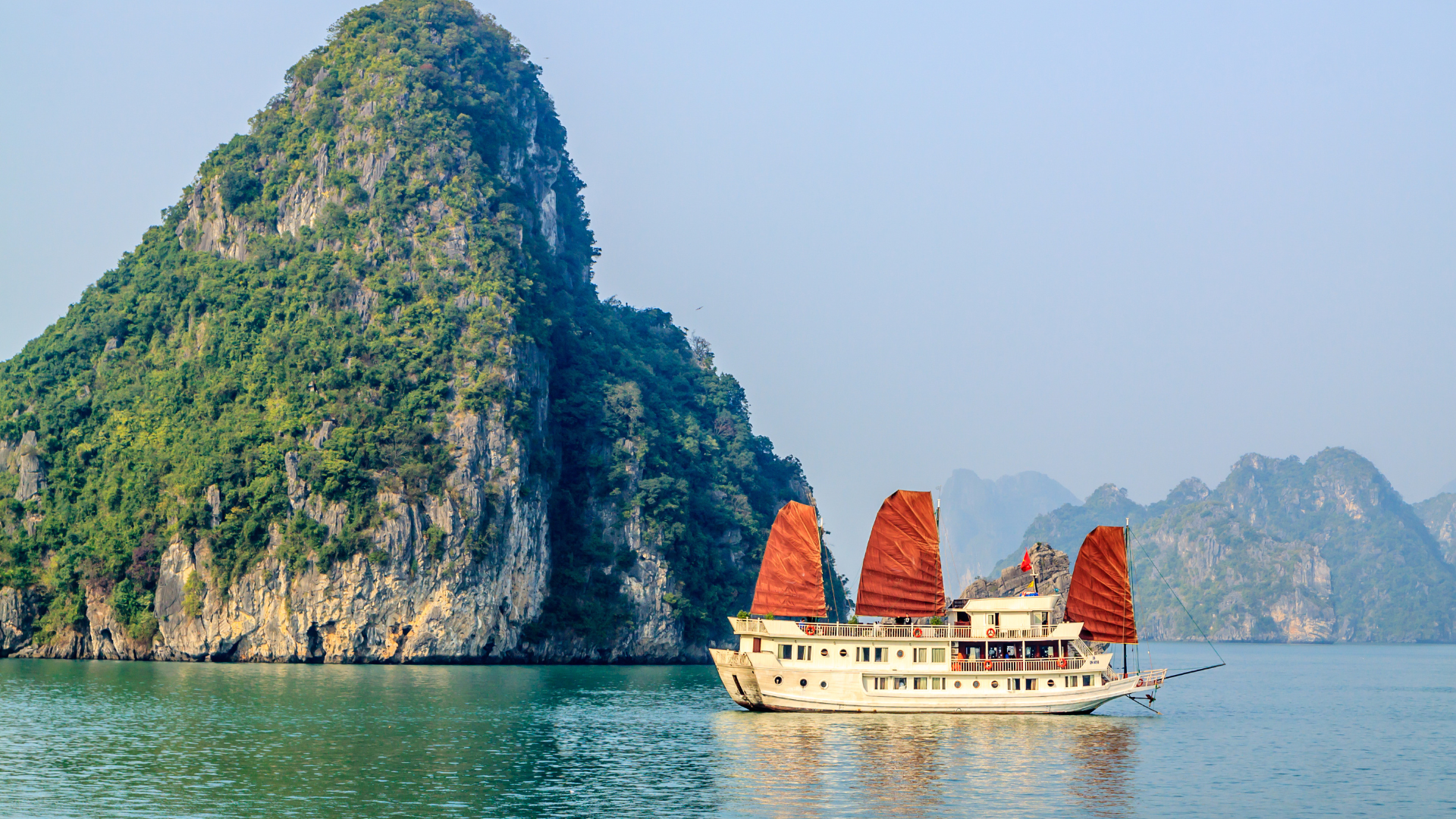
Two days and one night is the standard Ha Long Bay itinerary, and it is the right length. What most guides do not say is that the schedule is almost identical on every boat in the same price bracket, because the bay authority assigns fixed routes and fixed overnight anchorages. You are not choosing an itinerary. You are choosing a boat, and a price.
The second thing worth knowing before you book: day two is not a day. You are off the boat by 11:30 and back in Hanoi mid-afternoon. A 2D1N cruise buys you roughly one full afternoon, one evening, and one morning on the water.
Budget from about 1,250,000₫ (around $48) per person for a berth on a shared budget boat, and considerably more for a private cabin on anything mid-range. This guide covers what that actually includes, hour by hour, and which parts of the standard schedule are worth getting up for.
What the price actually covers
Almost every cruise quote is a package. The components underneath it are:
- Bay entry and overnight permit — 550,000₫ per person for route 2 with one night, the route that covers Sung Sot Cave, Luon Cave and Ti Top Island. Two nights on the same route is 750,000₫. Route 3, which visits Cua Van fishing village and Tien Ong Cave instead, is 500,000₫ with one night.
- Port passenger fee — quoted at 40,000₫ to 60,000₫ depending on the terminal and the source.
- The boat itself — cabin, meals, crew, kayaks, guide.
- Hanoi transfer — included by most mid-range and up, sometimes charged separately on budget boats.
The bay fee is not optional and cannot be bought independently by an individual traveller — overnight tickets are issued through the operator. If a quote looks unusually cheap, check whether the 550,000₫ is inside it or waiting for you at the pier.
Vietnamese seniors aged 60 and over get 50% off the bay fee with ID. Foreign seniors do not. Children under six and under 1.2m go free; from 1.2m or age seven they pay the adult rate.
Before you go
Book the boat, not the itinerary. Since the route is fixed, compare cabin size, whether the window opens, how many cabins are on board, and what the bar charges. A 20-cabin boat and a 8-cabin boat run the same schedule and feel completely different at Sung Sot.
Check the weather suspension rules. This is the single most important thing missing from most Ha Long guides. When a storm approaches, Quang Ninh province suspends departure permits for all passenger boats on the bay — overnight cruises are usually suspended first, several hours before day boats. This happened in July 2025 and again in July 2026. Sailings resume only after the meteorological agency issues its final storm bulletin. Refund and rebooking policy varies by operator and is worth reading before you pay, particularly between June and September.
Know which bay you are actually visiting. A number of cruises sold as “Ha Long” sail Lan Ha Bay in the Cat Ba archipelago, which is quieter, has a separate fee structure and a different departure point. Neither is worse. But if you booked expecting the classic route and the boat leaves from Cat Ba, you will not see Sung Sot or Ti Top. Ask which route number the boat holds.
Getting there. Hanoi to the marina is 155–170 km on the expressway, roughly 2.5–3 hours of driving. Door to door with hotel pickups and the mandatory rest stop, allow four hours.
Pack light. Cabin storage is small. A day pack covers it. Bring a swimsuit, quick-dry towel, sunscreen, a light jacket for the morning deck, motion sickness tablets, and cash in VND for the bar and tips.
Do not plan on bringing your own drinks. Most overnight boats prohibit outside food and alcohol, or charge a corkage fee. The bar is where the boat makes its margin.
Day 1: Hanoi to the bay
7:30 — Pickup in Hanoi
Shuttle collection from the Old Quarter. Pickups run in a loop, so an early slot can mean 45 minutes of driving around the same six streets before you leave the city. Sleep if you can.
11:30 — Arrive at the marina
Most classic-route boats leave from Tuan Chau, some from the Ha Long international passenger port. Check in at the operator’s desk, hand over passports for the sailing manifest, collect your cabin key.
Boarding is usually a queue. Everyone sailing that day checks in inside the same two-hour window.
12:00 — Lunch as you sail out
Vietnamese set menu or buffet depending on the boat. The karsts start appearing about 30 minutes out of the marina. The first hour of sailing is genuinely the best part of the schedule and nothing is asked of you during it.
14:00 — Sung Sot Cave
Dock at Bo Hon Island and climb a flight of steps to the entrance. Two large chambers, lit theatrically, with a viewpoint over the bay at the exit.
The downside, and it is a real one: 14:00 is peak. The cave is a one-way route, so several hundred people move through it at walking pace with no way to step aside. If your boat offers a later slot, take it. Allow 45 minutes. The steps are slippery.
15:30 — Kayaking at Luon Cave
Paddle through a low tunnel into a lagoon enclosed by cliffs. Macaques are sometimes on the rocks. This is the part of the itinerary most people remember.
It is also shared. At peak season several boats send their groups into the same lagoon in the same hour, so expect thirty other kayaks rather than solitude. Easy paddling, no experience needed, 1–1.5 hours, normally included in the cruise price. Bring a waterproof phone case.
17:00 — Cooking class
Spring rolls, about 20 minutes, on the sundeck. It is pleasant and it is also the point where the bar opens. Skippable without regret.
17:45 — Sunset from the deck
The boat anchors in a designated overnight area. Sunset times move by more than an hour across the year, so treat 17:45 as a summer figure — in December the light goes before 17:30 and the deck is cold.
19:00 — Dinner
Multi-course set menu, seafood-heavy. Vegetarian and allergy requests need to be given at booking, not on board; the boats provision for exactly the number of guests sailing.
20:30 — Squid fishing
The crew rigs lights off the back deck. Catching anything is unusual. What makes it worth doing is standing on a dark deck between karsts with the engines off, which is not an experience the daytime schedule gives you.
Day 2: Sunrise to Hanoi
6:00 — Tai chi, or coffee
Morning mist sits between the karsts and the bay is quiet before the day boats arrive. The tai chi class is optional and mostly ceremonial. Being awake is the part that matters.
7:00 — Breakfast
Buffet, Vietnamese and Western.
8:30 — Ti Top Island
A short stop with two options. Climb to the viewpoint on the 100m peak — sources put the staircase at 400 to 450 steps — for a 360-degree view of the anchorage. Or swim from the crescent beach, which is warm from May to September.
The downside: the staircase is narrow, two-way and fully exposed, and every boat in the area arrives within the same 90 minutes. In July and August the climb is hot and slow. The beach is small and gets crowded for the same reason.
10:00 — Check out and sail back
Cabins are vacated while the boat returns to the marina. Light brunch served on the way in.
11:30 — Disembark
Shuttle back to Hanoi, arriving around 15:30–16:00.
What to skip, and who should not book this
Skip the cooking class and the tai chi if you would rather sleep or sit on the deck. Neither is why you came.
Skip the 2D1N entirely if the forecast is poor between June and September. A cancelled sailing at short notice is common, and a cruise in heavy rain is a boat with a wet deck and no view.
Consider a day trip instead if you are short on time and mainly want to see the karsts. A route 2 day boat covers Sung Sot, Luon and Ti Top and costs about 310,000₫ in fees plus the boat. You lose the evening and the morning, which are the two hours per day the bay is quiet — but you also lose the transfer overhead.
Consider three days instead if you want more than one afternoon of activity. The extra night mostly buys a day-boat excursion deeper into the bay rather than 24 more hours; we broke that down in our 2D1N vs 3D2N comparison.
This is not a good trip for anyone who needs step-free access. Sung Sot and Ti Top are both staircases with no alternative route, and boat-to-tender transfers are done from a moving platform.
What it costs, per person
Cruise prices in Vietnamese operator listings run roughly like this, per person per night:
- Shared berth on a budget boat — from about 1,250,000₫ (around $48)
- Standard cabin, 3–5 star boat — 2,500,000₫ to 5,800,000₫ per cabin (around $96–222), so half that each for two sharing
On top of the cruise fare, budget for:
- Bar drinks — 300,000₫ to 800,000₫ (about $11–31), and more on luxury boats
- Crew tip — 130,000₫ to 260,000₫ (about $5–10) per person is the usual range
- Kayak, cave entry, Hanoi transfer — normally included, but confirm in writing
A realistic all-in figure for a mid-range 2D1N in 2026 is 3,000,000₫ to 4,500,000₫ per person (about $115–172), assuming two people sharing a cabin and a moderate bar tab.
Prices are indicative and move with season — check at booking.
FAQ
Is one night enough in Ha Long Bay? For most people, yes. One night gives you the two quiet windows — evening and early morning — that day trippers never see. Add a second night only if you want more time on the water rather than more sights.
What happens if a storm cancels the cruise? The provincial authority suspends departure permits and no boat sails, regardless of operator. Rebooking and refund terms are set by the operator, not the province, so read them before paying. This is a real risk from June to September.
Can I buy the bay ticket myself and turn up at the pier? No. Overnight tickets are issued through the cruise operator. Day-trip tickets can be bought at the terminal.
Is Ha Long Bay too crowded to be worth it? The fixed points on the route — Sung Sot at midday, Ti Top mid-morning — are crowded, and there is no way around that. The sailing time between them, and the overnight anchorage, are not. Book a smaller boat and the ratio improves.
Ha Long Bay or Lan Ha Bay? Lan Ha is quieter and the scenery is comparable. Ha Long has the famous caves. If it is your first visit and you want the postcard, take the classic route; our Cat Ba guide covers the alternative.
Sailed recently, or had a cruise cancelled on you? Tell us in the comments — we update this guide as fees and route rules change.