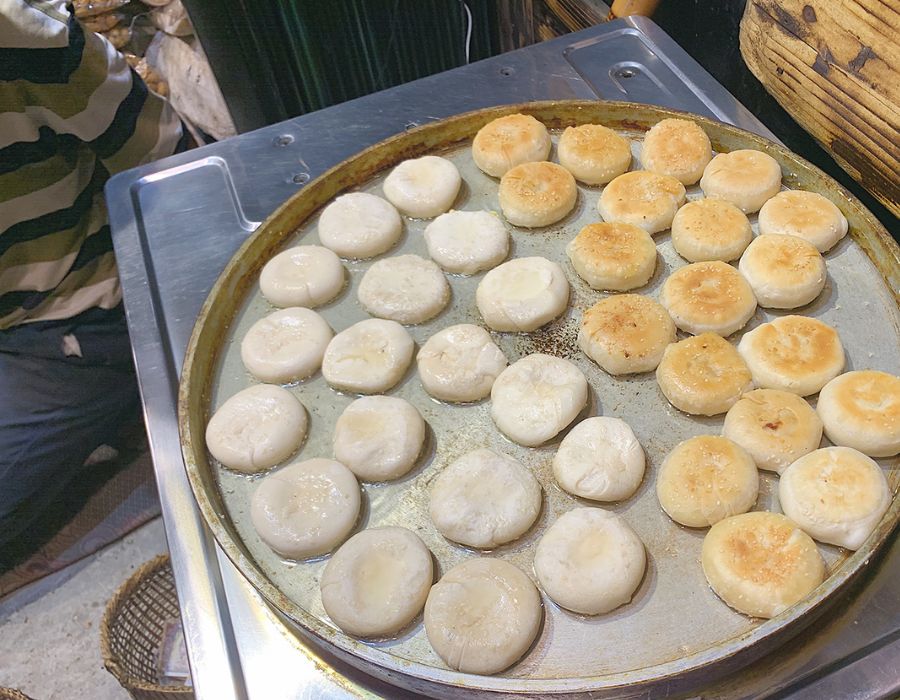
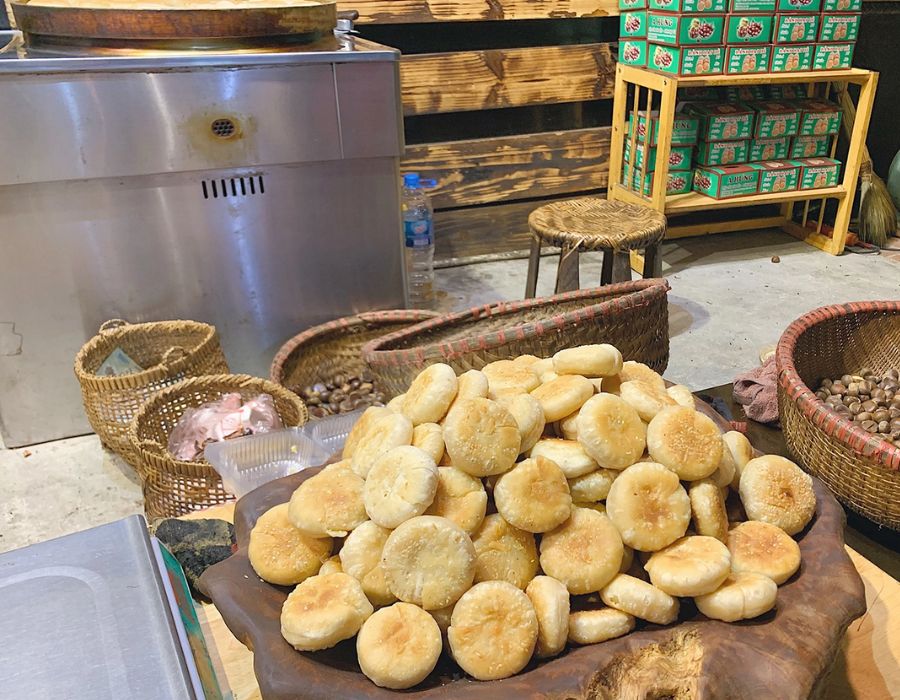
Sapa chestnut cake is a palm-sized disc of thin wheat pastry packed with ground chestnut, cooked on a hot griddle until both sides go gold, and sold from street carts for 10,000₫ (about $0.40). Eaten within a minute of coming off the griddle, it is one of the better cheap snacks in northern Vietnam. Bought cold from a box, it is a fairly ordinary sweet pastry.
That gap is the entire point of this post. The cake is worth trying, the boxes sold as gifts usually are not, and the price you are quoted depends on whether the vendor thinks you know what it costs.
🌰 WHAT BÁNH HẠT DẺ ACTUALLY IS
Two layers, nothing more. The outside is a thin wheat-flour shell, sometimes scattered with sesame seeds. The inside is chestnut, boiled and ground to a paste and sweetened.
It is cooked flat on an oiled griddle or in a shallow pan, pressed, and turned once. Some stalls sign themselves bánh hạt dẻ nướng, which translates as baked, but what you will watch happen is closer to pan-frying. The result is crisp at the edge, soft through the middle, and about as sweet as a mooncake but much lighter.
The taste is nutty and mild rather than sugary. If you have eaten Chinese chestnut cake or a Japanese kuri manju, you know the flavour already — this is a rougher, cheaper, hotter version of the same idea, and the temperature does most of the work.
Sapa sits at around 1,500m and is cold and wet for much of the year. A hot cake handed over in paper on a foggy street is a different product from the same cake at room temperature. Buy it where you can see the griddle working.
💰 WHAT IT SHOULD COST
The going rate across Sa Pa in 2026 is 10,000₫ per cake. Boxes of ten run roughly 80,000₫ to 90,000₫.
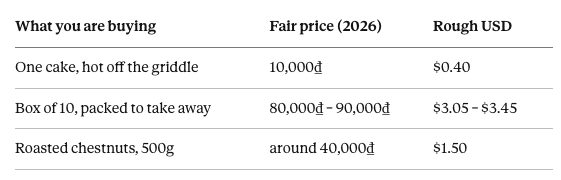
Older guides still quote 5,000₫ to 8,000₫ a piece. That number is several years out of date and repeating it will only make you think you are being cheated when you are not.
The real thing to watch is the opposite. Recent visitor reviews of Sa Pa stalls describe being quoted 60,000₫ for two cakes, and boxes priced well above the local rate. This is not universal and it is not most vendors — it is what happens anywhere a stall gets a lot of one-time customers who have no reference price. Ask for the price per piece before you hand over money, and hold up the number of cakes you want. Nobody minds; it is a normal transaction, not a confrontation.
Bring small notes. Chestnut cake stalls are cash only and a 500,000₫ note for a 10,000₫ cake will hold up the queue.
🥜 ARE THE CHESTNUTS ACTUALLY FROM SAPA?
Often not, and it is worth understanding why before you pay a premium for a box labelled hạt dẻ rừng — forest chestnut.
Chestnuts in northern Vietnam are seasonal. The main harvest runs roughly September to December, with the peak in autumn. Bánh hạt dẻ, meanwhile, is sold in Sa Pa every day of the year. The gap is filled largely with imported chestnut, mostly from China, which is cheaper, larger and available year-round. A Vietnamese report on the trade quoted a seller saying that customers who ask only in passing are told the nuts come from Sa Pa because it makes them easier to sell, and that the price alone tells anyone experienced that they are not domestic.
None of this makes the cake bad. Ground into a sweetened paste and cooked, imported chestnut and local chestnut are hard to tell apart, and at 10,000₫ nobody is being robbed. It matters for one decision only: whether to pay extra for a box marketed on its Sa Pa origin, particularly outside the autumn harvest window. Between September and December that claim is at least plausible. In April it is a marketing line.
If you want the local product with the least ambiguity, buy roasted chestnuts loose in autumn rather than cakes in a printed box.
📍 WHERE TO BUY IT IN SA PA
Three places worth your time. All are in the town centre, walkable from the stone church.
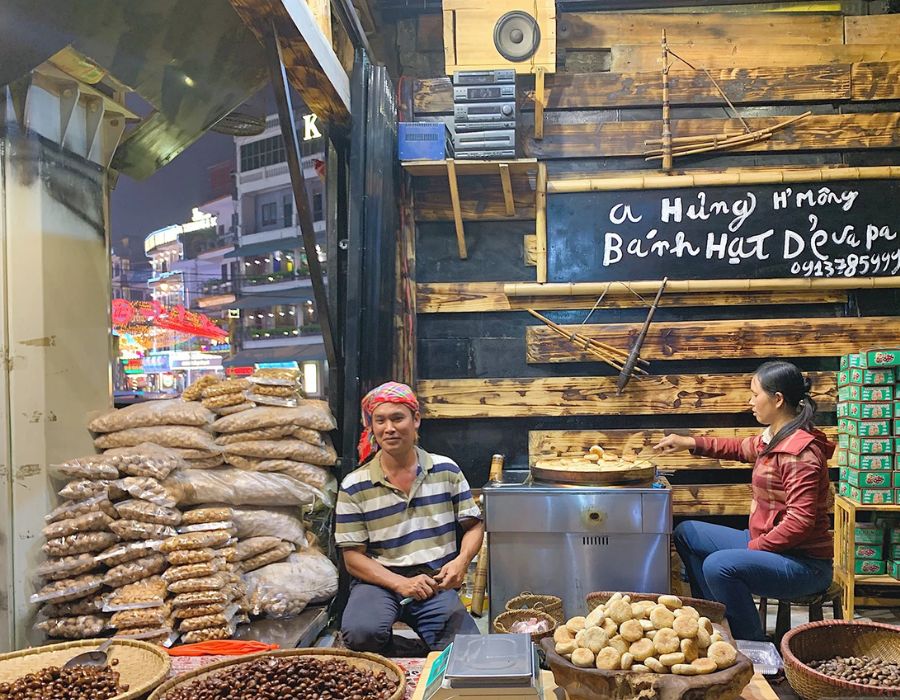
A Hưng H’mông — 8 Thạch Sơn
The stall most consistently recommended by visitors who tried more than one. 10,000₫ a cake, cooked in front of you, and they roast and sell chestnuts by weight alongside — around 40,000₫ for half a kilo. Reviewers mention being offered a taste before buying, which is a good sign anywhere in Vietnam.
Small operation, no seating, no English menu and none needed. Around a 5-minute walk from the stone church.
Hạt Dẻ Sapa – Lý Mẩy — đường N2, beside Chợ Sapa
The one to use if you actually want to take cakes home. They vacuum-seal boxes, include storage instructions, and let you taste first. They also make a chestnut-and-shiitake version, which is less sweet and the more interesting of the two if you have already had the standard one.
Reviews note the stall trades from late afternoon at the market end. Do not plan a morning stop here.
Sa Pa Night Market — Lương Định Của
Open roughly 6:30pm to 11:30pm, in front of Sapa Market, and busy from about 6:30pm onward. Several carts sell chestnut cakes among the grill stalls, and it is the easiest place to eat one hot without planning anything.
It is small, most stalls sell similar things, and prices here are quoted a little higher than at fixed shops. That is the trade-off for convenience.
🚫 WHERE NOT TO BOTHER GOING
A lot of Vietnamese-language guides list Bắc Hà market, Cốc Ly market and Mường Hum market as places to buy bánh hạt dẻ Sapa. They are real markets and they are genuinely interesting, but they are not in Sa Pa. Bắc Hà is about 100km away and only runs on Sundays. Cốc Ly is Tuesdays. Mường Hum is in the former Bát Xát district, a different direction entirely.
Each is a full-day trip. Going for a 10,000₫ pastry you can buy 300m from your hotel is not a plan; go for the market itself, and treat the cake as incidental.
Worth knowing for addresses generally: since 1 July 2025 Sa Pa is administratively phường Sa Pa, Lào Cai province. District level was abolished nationwide, so any address written as “thị trấn Sa Pa, huyện Sa Pa” is pre-2025. Taxi drivers and Google Maps still handle the old wording without trouble.
🍽️ EATING IT AND TAKING IT HOME
Eat the first one standing at the stall. It genuinely does not survive the walk back.
For cakes taken away, reheat in a dry pan or an air fryer. Do not deep-fry them again — the shell soaks up oil and the whole thing turns heavy.
Shelf life is where sellers disagree with each other. Claims range from two days to a month depending on which shop you ask and whether the cakes were vacuum-packed or handed over in a paper bag. Treat loose cakes as a two-to-three day item, ask specifically about the packed boxes, and assume anything with white spots or a sour smell goes in the bin.
If you are flying out of Hanoi several days later, this is not a strong souvenir. Vacuum-packed boxes travel better than loose ones, but chestnut cake is at its best about ninety seconds after it is made and there is no packaging that fixes that.
🗣️ OUR HONEST TAKE AS LOCALS
It is a good 10,000₫ snack and a mediocre 90,000₫ gift box.
The honest drawback: it is one flavour, one texture, and repetitive. The first hot cake on a cold evening is a small pleasure. The third is dense, oily and dull, and a box of ten will be finished by nobody in your household. Sweet, soft, heavily starch-based — anyone avoiding gluten or watching sugar should skip it entirely.
Who it suits: anyone walking through Sa Pa town in the evening who wants something warm for the price of nothing. Buy one, eat it on the spot, and decide from there whether a box is worth carrying.
Who should skip it: people expecting a chestnut dessert with any complexity, and anyone hoping to bring home a Vietnamese speciality that will still be good next week. For that, roasted chestnuts in season, or dried buffalo meat, hold up far better.
READ NEXT: 3 SAPA GUIDES TO PLAN A BETTER TRIP
If one hot chestnut cake is your Sa Pa street-snack checkpoint, use these next guides to build the rest of the mountain trip without wasting half a day in fog and traffic.
- Hanoi to Sapa: Limousine, Sleeper Bus or Night Train? — compare 2026 fares, travel time and which option leaves you least wrecked on arrival.
- Sapa’s Best Season Isn’t the One You Saved on Instagram — match chestnut season with mist, rice terraces and the short local window worth waiting for.
- The 6 Rice Terrace Viewpoints in Sapa Worth Your Legs — spend your walking energy on views that actually pay you back.
❓ FAQ
How much is bánh hạt dẻ in Sapa? 10,000₫ per cake in 2026, or 80,000₫ to 90,000₫ for a box of ten. Anything materially above that is a tourist price.
Is Sapa chestnut cake sweet? Mildly. Closer to a mooncake than a Western pastry, and less sugary than it looks. The chestnut flavour is nutty rather than sweet.
Can I take it on a plane? Yes, it is not a restricted item, but the quality drops fast. Vacuum-packed boxes are the only version that travels reasonably.
When is chestnut season in Sapa? Roughly September to December, peaking in autumn. Cakes are sold year-round regardless, using stored or imported nuts.
Is it vegetarian? The standard filling is chestnut, flour, sugar and oil, so generally yes. Ask at the stall if it matters to you, since a few vendors sell savoury variants from the same griddle.
Have you tried bánh hạt dẻ in Sa Pa — and did you pay 10,000₫ or something rather different? Tell us what you were quoted and where. 👇