Sapa is about 315km from Hanoi. The bus takes 5 to 7 hours and costs 250,000–450,000₫ (~$10–17). The train takes 9 to 10 hours door to door, costs more, and is the only option where you arrive having actually slept.
There’s no wrong answer here, but there is a wrong answer for your specific trip, and it usually comes down to whether you’re willing to lose a daylight afternoon.
The short version
| | Bus / limousine | Night train + transfer | | Total time | 5–7 hours | 9–10 hours | | Cost | 250,000–450,000₫ | From ~375,000₫, up to 1,800,000₫ | | Arrives | Wherever you booked, in Sapa town | Lào Cai station, then 1 more hour by road | | You lose | Half a day of daylight | A night’s sleep, but in a bed | | Best for | Short trips, tight budgets, anyone prone to motion sickness | Anyone who wants a full first day in Sapa |
Why it takes as long as it does
The road splits into two very different halves, and this is the part most guides skip.
The first 265km is the Nội Bài–Lào Cai expressway. It’s fast, modern, and takes 3.5 to 4 hours.
The last 30–40km is Highway 4D, climbing from the valley floor up to Sapa at around 1,500m. That short stretch takes another 1 to 1.5 hours, and it is a genuine mountain pass — switchbacks, gradient, and a lot of cornering.
So: most of the distance is easy, and the last tenth is the part people remember. If anyone in your group gets carsick, this is the section that decides it. Take something before you board, not when you start feeling it.
Option 1: Limousine and cabin buses
The most popular choice, and for most travellers the right one.
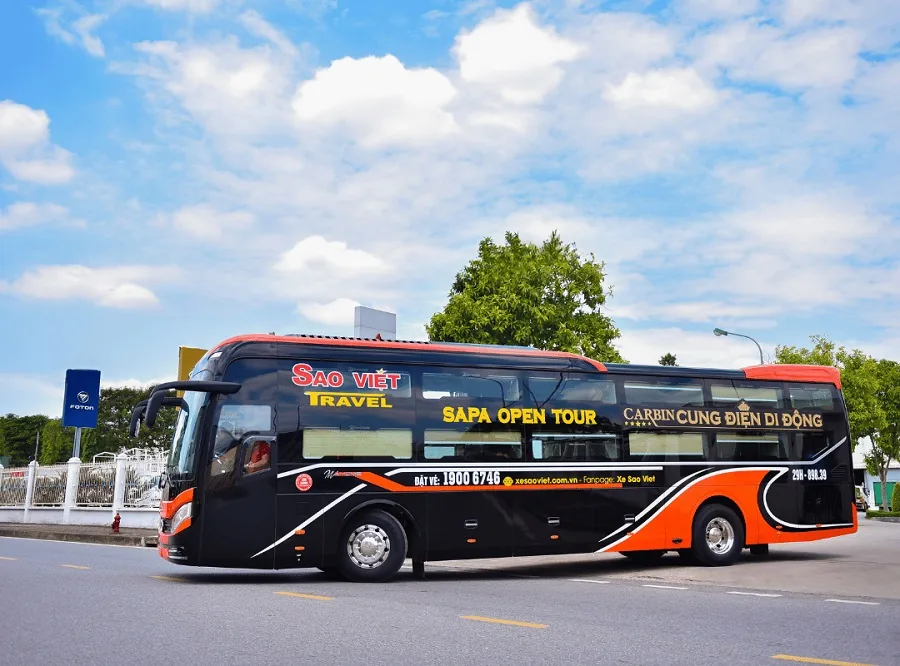
“Limousine” in Vietnam means a 9 to 28-seat van with wide reclining seats rather than bunks. “Cabin” buses give you an enclosed private berth with a curtain or door. Both sit at the upper end of the price range.
What you get: reclining or fully flat berths, USB charging, wifi, bottled water, and — with most operators — a free shuttle that collects you from your hotel inside central Hanoi.
The catch on that shuttle: it collects several passengers before the main departure, so budget an extra 45 minutes to an hour at the start of your day. If you’re staying in the Old Quarter, walking to the operator’s office is often faster than being picked up from it.
Pickups in Hanoi cluster around the Old Quarter, Trần Quang Khải and Trần Nhật Duật. Several operators also collect directly from Nội Bài airport terminals, which is worth knowing if you’re flying in and going straight up — note the airport pickup point clearly when you book, or you’ll be dropped at the wrong door.
At the Sapa end, buses stop either in the town centre on Điện Biên Phủ or at Sapa bus station on the edge of town. Check which one your ticket means. They are not the same place.
Option 2: Standard sleeper buses
The 36 to 40-berth sleeper coach is the cheap version, and there’s nothing wrong with it if you know what you’re getting.
Berths are narrower, upper bunks are cramped for anyone tall, and the bus makes more stops. You’ll pay at the bottom of the range and arrive in the same 5 to 7 hours, occasionally slower.
Worth taking if the price difference matters to you. Not worth taking if you’re over about 180cm.
Option 3: The night train
There is no railway station in Sapa, and this is the single most misunderstood thing about the route. Trains run from Hanoi to Lào Cai, which is 35–38km away, roughly an hour by road.
Night trains leave Hanoi around 21:30–22:00. The most consistently scheduled pair is SP3, departing 22:00 and reaching Lào Cai at 05:55, returning as SP4 from Lào Cai at 21:30 into Hanoi at 05:25.
Departure station: trains to Lào Cai leave from the rear side of Hanoi station, 1 Trần Quý Cáp, not the main colonial-era entrance on Lê Duẩn everyone photographs. Two different doors, several minutes apart on foot. Arrive an hour early the first time.
What you actually pay for. Two things run on the same train and they are priced very differently.
- The national railway’s own 4-berth air-conditioned soft sleeper starts around 375,000₫ (~$14). Book at dsvn.vn.
- Private tourist operators — Chapa Express, Sapaly, Livitrans, King, Hara, Laman and others — attach their own wood-panelled carriages to the same service. A berth in a 4-person cabin runs roughly 790,000–990,000₫ (~$30–38); 2-berth VIP cabins go from about 1,500,000₫ (~$58) up.
The private carriages are genuinely nicer. Whether they’re three times nicer is a question only you can answer at 22:00 on a Tuesday.
Discounts on national railway tickets: free under 6, 25% off for ages 6 to under 10, 10% off for students, 15% off for over-60s, 30% off for war invalids and people with severe disabilities.
The hour nobody tells you about
You get off at Lào Cai at 05:55 and you are not in Sapa. You still have 35km of mountain road ahead.
Shared minibuses wait outside the station and leave when full. Several train operators sell a transfer with the ticket, which is worth taking if you’d rather not negotiate at six in the morning in the dark.
Then the second problem: you reach Sapa around 07:00 and no hotel will check you in before noon. Either book the previous night so the room is already yours, or pick somewhere that will hold your bags and let you use a shower. Ask before you book — plenty of places will, but not all of them.
When to book
Right now, if you’re coming for the rice.
The terraces in the Mường Hoa valley turn gold from late August, and the fullest colour is usually around 10–15 September, though it shifts by a week or two with the weather and by altitude. It’s the busiest stretch of the Sapa year.
It also collides with Vietnam’s National Day holiday. In 2026 the public-sector break runs five straight days, Saturday 29 August to Wednesday 2 September. Domestic demand on this route over those dates is heavy, and operators raise prices — expect 10–30% above normal on holidays, weekends and through the summer.
For travel in that window, book weeks ahead rather than days. For an ordinary weekday in a quiet month, a day or two is usually fine.
One thing about the name
Since 1 July 2025, Yên Bái province has been merged into Lào Cai province, and the old Sa Pa town has been reorganised — the tourist centre is now Sa Pa ward, Lào Cai province.
Nothing about your journey changes. Operators, tickets and signs all still say Sa Pa. But if you’re reading an address that says “Sa Pa town, Lào Cai” and wondering whether it’s out of date, that’s why.
So which one
Take the bus if you’re on a short trip, watching the budget, or want to arrive in Sapa itself rather than an hour short of it. Leave in the morning and you’re there for a late lunch.
Take the train if you have limited days and can’t spare a daylight afternoon, if you’re travelling with older parents who won’t enjoy 90 minutes of switchbacks awake, or if you simply sleep better lying flat. Book the private cabin if the extra 400,000₫ buys you an actual night’s sleep; book the national railway sleeper if it doesn’t.
Take the standard sleeper coach if the price gap is the deciding factor and you’re not tall.
The one option to avoid is booking the train and not planning the Lào Cai transfer. That’s how people end up standing outside a station at dawn paying whatever they’re asked.
FAQ
Is there a train station in Sapa? No. The nearest is Lào Cai, 35–38km away, about an hour by road.
How long does the bus take from Hanoi to Sapa? 5 to 7 hours for roughly 315km — about 3.5 to 4 hours on the expressway, then 1 to 1.5 hours climbing Highway 4D.
How much is the train? From around 375,000₫ for a national railway 4-berth soft sleeper. Private tourist cabins run roughly 790,000–990,000₫ for a 4-berth and from about 1,500,000₫ for a 2-berth VIP. Prices rise on holidays and weekends.
Can I get picked up at Nội Bài airport? Some operators collect directly from the terminals. Note it clearly when booking.
When do the rice terraces turn gold? Late August into September, usually fullest around 10–15 September, varying with weather and altitude.
Which is better for motion sickness? The train, by a distance. Whatever you take, the last 30–40km is a mountain pass.