Quick booking links:
Somewhere on your phone there is a photo of Sapa.
Golden terraces stacked up a mountainside like a staircase built for someone much larger than us. Mist caught halfway down the valley. A woman in indigo walking a buffalo along a ridge, small enough to be a comma in the frame.
We know that photo. We also know it was taken in a window of about eleven days, probably before seven in the morning, probably in a year when the rain behaved.
That’s not a warning. Sapa is worth every hour of the road to get here. But if you’re going to spend two nights and a lot of money on a mountain in northwest Vietnam, you deserve to know what you’re actually walking into — and which season we’d send our own friends to.
Let us tell you a secret first: it isn’t September. 🌾
🌫️ WHAT SAPA’S WEATHER ACTUALLY DOES
Sapa sits somewhere between 1,500 and 1,600 metres up in what was Lào Cai province, in Vietnam’s far northwest. That altitude is the whole story. While Hanoi is melting at 38°C, Sapa is sitting at 20°C with a breeze that smells of woodsmoke and wet grass.
Average temperatures hover between roughly 15°C and 18°C for most of the year. In deep winter it can drop below zero. Frost glazes the cabbage fields some mornings. And once every few winters — not every winter, whatever the viral photos suggest — a thin, disbelieving layer of snow falls on the higher slopes and the whole of Vietnam loses its mind for forty-eight hours.
The rain matters more than the cold. July and August are the wettest months by a wide margin, and in the mountains rain doesn’t just mean an inconvenient afternoon. It means slick red-clay trails, occasional landslides on the pass roads, and valley views that vanish into white for two days straight.
So the real question isn’t “when is Sapa nice.” Sapa is almost always nice. The question is: what do you want to see when you look down?
🌾 MID-SEPTEMBER TO MID-OCTOBER — THE GOLD, AND THE TRUTH ABOUT IT
This is the season on your phone. It’s real and it’s genuinely staggering.
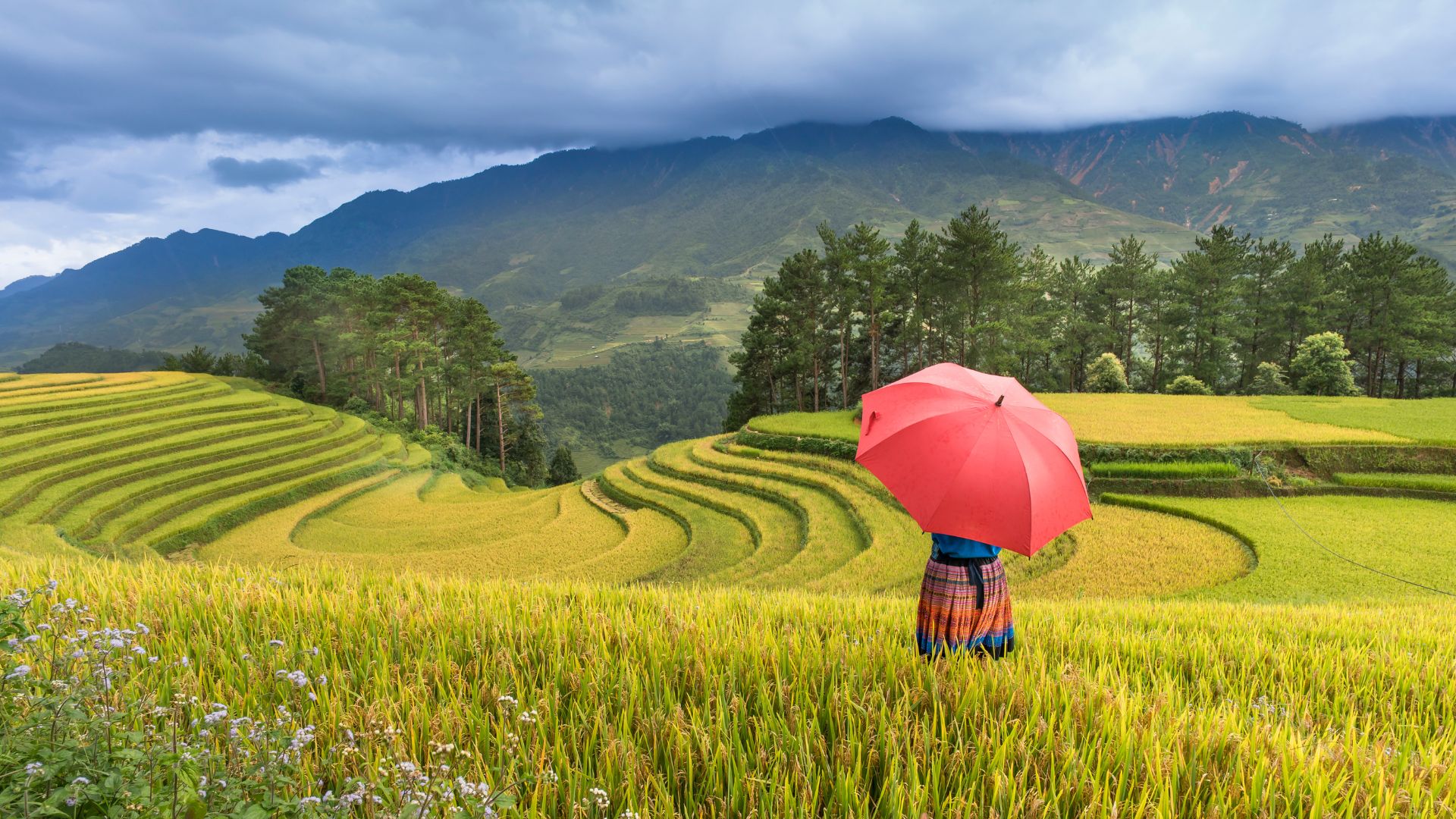
Across the Mường Hoa Valley — through Lao Chải, Tả Van, Y Linh Hồ — around 10,000 hectares of terraces turn the colour of a struck match. In the last days before cutting, the rice heads are heavy enough that the whole hillside moves in the wind like water. At six in the morning, with the mist still sitting in the bottom of the valley and the light coming in sideways, it does something to your chest.
Here is what the photos don’t tell you.
The window is narrower than the internet implies. Most sources will say “September to October,” which is technically true and practically useless. The real peak — full gold, not yet cut — is usually the last week of September into the first week of October, and it shifts with the year’s weather.
The fields are also harvested in stages, not all at once. Families cut when their own rice is ready. So you will very likely find one slope blazing gold and the next one already cropped to stubble, with a family working their way across it in a line. Honestly? We think that’s the better photograph. It’s a working landscape, not a set.
And it is busy. This is the most popular fortnight of the Sapa year. Homestays in Tả Van book out, the cable car queue stretches, and the trails have other people on them. Book weeks ahead or don’t come in this window at all.
💧 LATE APRIL TO EARLY JUNE — THE SECRET WE’D ACTUALLY GIVE YOU
Now the part nobody puts on a postcard.
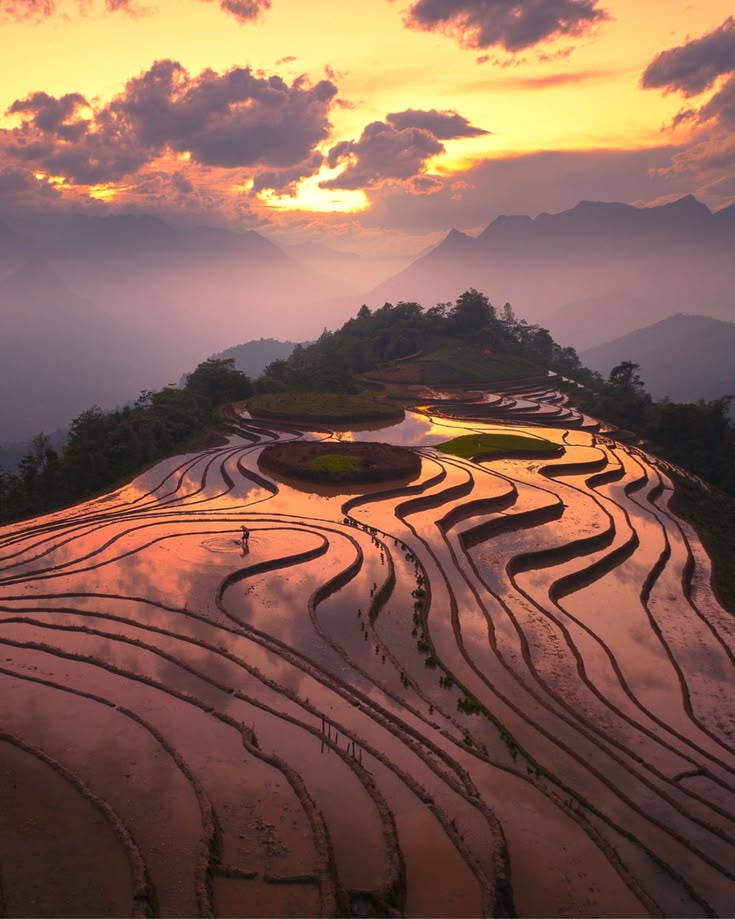
For a few weeks in late spring, the farmers flood the terraces to prepare them for planting. The mountainside fills with still, shallow water — thousands of small pools, stepped down the slope, each one holding a piece of the sky.
Locals call it mùa nước đổ, the water-pouring season. At dawn the whole valley turns into a broken mirror. Clouds, ridgelines, a passing bird — all of it doubled and shivering. When the light goes pink just before sunrise, the terraces go pink with it.
It is, in our completely biased opinion, more beautiful than the gold.
It’s also quieter. The crowds haven’t arrived. Homestay prices are lower. The trails are firm underfoot compared to high summer, and the air still has that cool, rinsed clarity of spring. You will share a viewpoint with three photographers instead of thirty.
The trade: the reflections need still water and calm mornings, so a windy or rainy dawn flattens the whole effect. Give yourself two or three mornings, not one. Get up before you want to. Bring something warm — the pre-dawn cold at 1,600 metres is not a joke, even in May.
If you only ever visit Sapa once and you want the version fewest people have seen, come now.
🍃 JULY AND AUGUST — GREEN, WET, CHEAP AND HONEST
By midsummer the rice is tall and impossibly green. Not one green — dozens of them, layered up the hillsides, moving constantly.
This is also the rainiest stretch of the year, and we won’t pretend otherwise. Trails turn to slick clay. Afternoon storms roll in with very little warning. Mountain roads occasionally close.
But there’s something about Sapa in the rain that we’d defend to anyone. The clouds come down into the villages. Everything smells of wet earth and cut wood. You end up in a homestay kitchen with a bowl of thắng cố or a local chicken hotpot going, condensation on the window, someone’s grandmother feeding the fire, and nowhere at all to be.
Rooms are cheaper. The town is calmer. If you’re travelling on a budget and you have a flexible attitude and decent shoes, this is a genuinely lovely time to be here. If you have exactly one free day and a fixed idea of the photo you want, it isn’t.
❄️ NOVEMBER TO FEBRUARY — WHEN SAPA STOPS PERFORMING
The terraces are cut and bare. Brown, structural, stripped back to their bones. The valley looks like an architectural drawing of itself.
Some people find this disappointing. We find it the most atmospheric Sapa of all.
This is cloud season. On clear cold mornings the valley fills with a solid white sea and the ridges rise out of it like islands. It’s also when the mountain is at its quietest, and when the ethnic communities here hold some of their most important festivals — the H’Mông Gầu Tào and the Giáy Roóng Poọc among them, generally clustered around and after Lunar New Year.
Come dressed properly. Below 10°C with mountain damp cuts through more than the number suggests, and many older guesthouses are not heated in any meaningful way. Bring layers, bring a hat, bring the thermal you thought was excessive.
Then sit outside with a corn wine and watch the fog move through the pines. That’s the whole activity. That’s enough.
🌸 MARCH AND EARLY APRIL — THE BLOSSOM WINDOW
Between the cold and the water, the hillsides do something brief and lovely.
Peach and white plum blossom open across the slopes and around the villages. The grass comes back. Trails are dry and firm — this is arguably the best pure trekking window of the year, before the summer mud and without the winter chill.
The terraces themselves are still empty at this point, so if the rice fields are your main reason for coming, this isn’t your month. But if you want walking weather, flowers, and villages that still feel like they belong to the people who live in them rather than to the season, March is a quiet gift.
🚡 THE FANSIPAN QUESTION
At 3,143 metres, Fansipan is the highest point in Vietnam, and the cable car turned what used to be a two-day climb into a twenty-minute ride.
As of 2026, a round-trip adult cable car ticket is 850,000 VND, with a surcharge on Saturdays and public holidays. Children between 1.0m and 1.4m are 550,000 VND, and under a metre rides free. The Mường Hoa mountain train from central Sapa to the cable car base is a separate 200,000 VND return, and there’s a funicular at the top if you’d rather not take the final 600 steps. It adds up — this is comfortably the most expensive single outing in Sapa.
Is it worth it? On a clear morning, absolutely. Book the earliest slot you can and be in one of the first cabins. Cloud builds through the day, and by midday the summit is very often inside it, which means you’ve paid a lot of money to ride six kilometres through a white void.
Check the forecast the night before. If it says solid fog, spend the money on a two-day valley trek with a homestay instead. That’s not us being frugal — that’s the better day out.
📅 SO WHICH MONTH? A STRAIGHT ANSWER
You want the golden terraces: last week of September to first week of October. Book everything early.
You want the mirror terraces and fewer people: mid-May to early June. This is our pick.
You want the best walking: March to early May, or October to November.
You want cloud seas and atmosphere: late November to February. Dress for it.
You want it cheap and green and don’t mind mud: July and August.
You want a guarantee of clear mountain views: we can’t give you one. Nobody here can. That’s mountains.
💬 OUR HONEST TAKE AS LOCALS
Sapa has changed. There are more hotels than there were, more concrete on the edge of town, more people in the valley at harvest. Some of what you’ll read online was written about a Sapa that existed fifteen years ago, and we’d rather tell you that than let you arrive expecting it.
But walk forty minutes out of town in any direction and it’s still there. The terraces are still cut by hand into slopes that have no business being farmed. Families still work them the way their grandparents did. The mist still comes down the valley at four in the afternoon and swallows everything, and you still stop walking when it does, because there’s nothing else to do but stand there and let it happen.
Our honest advice is this: don’t come for eleven days of gold. Come for four days of whatever the mountain decides to give you. Book a homestay in the valley rather than a hotel in town. Walk more than you planned. Eat in the kitchen. Let one morning be foggy and don’t resent it.
Sapa isn’t a photograph you’re going to collect. It’s weather, and you’re standing in it.
So — which season are you coming for? Tell us below, and if you’ve already been in the water-pouring season, we want to hear whether you agree with us that it beats the gold. 👇
Planning northern Vietnam properly? Start with our Sapa destination guide — and if you’re routing through the capital first, our Hanoi guide is here
Prices and seasonal windows verified August 2026. Harvest and water-pouring dates shift by a week or two each year with the weather — check locally before locking in non-refundable dates.