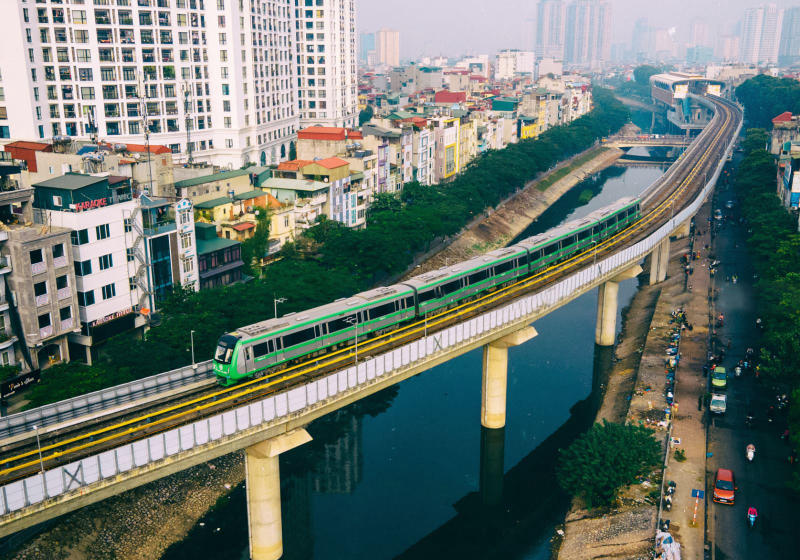
Here’s a little secret most tourists never figure out: one of the best views of Hanoi costs less than a dollar, comes with air conditioning, and doesn’t involve a single tour bus. 🚇
It’s the Cat Linh – Ha Dong metro line. Hanoi’s first-ever elevated train, and honestly? One of my favorite ways to show visiting friends a side of the city that no walking tour of the Old Quarter will ever give you.
Most travel itineraries skip it completely. Big mistake. Let me tell you why — and exactly how to ride it like you’ve lived here for years.
WHY A METRO LINE DESERVES A SPOT ON YOUR ITINERARY 🌅
I know what you’re thinking. “It’s a commuter train. I have those at home.”
Sure. But yours probably doesn’t glide 13 kilometers above one of Southeast Asia’s most chaotic, beautiful, alive cities. From up there, you see Hanoi the way locals never slow down enough to see it: rooftop gardens crammed with bonsai, laundry fluttering between apartment blocks, the To Lich River snaking below, motorbikes swarming the streets like schools of fish.
Ride it at sunrise — trains start at 5:30 AM — and you’ll watch the city wake up beneath you. Street vendors setting up pho stalls. Tai chi groups in tiny parks. Golden light hitting a thousand tin roofs. It’s genuinely cinematic, and it costs about as much as a stick of grilled corn.
And here’s the local twist: for young Hanoians, this metro isn’t just transport. It’s a full-blown photo destination. On weekends you’ll see couples in matching outfits, students in ao dai, and photographers staking out the platforms. The stations have this clean, minimal, almost Korean-drama aesthetic that made them famous on Vietnamese social media. When in Hanoi, do as Hanoians do — bring your camera.
THE BASICS: WHAT IS THE CAT LINH – HA DONG LINE? 🚉
Quick orientation so you sound smart at the hostel bar:
This is Line 2A, Hanoi’s first metro line. It runs 13 km on elevated tracks from Cat Linh station (near the city center, walkable-ish from the Temple of Literature) southwest to Yen Nghia station in Ha Dong district, stopping at 12 stations along the way.
The full ride takes about 25 minutes end to end. The stations, in order:
Cat Linh → La Thanh → Thai Ha → Lang → Thuong Dinh → Vanh Dai 3 → Phung Khoang → Van Quan → Ha Dong → La Khe → Van Khe → Yen Nghia
For most travelers, you’ll board at Cat Linh — it’s the station closest to the tourist zone, about a 10-minute taxi from Hoan Kiem Lake or a 15-minute walk from the Temple of Literature.
SCHEDULE: WHEN DO TRAINS RUN? ⏰
Trains run every single day, including weekends and public holidays, from 5:30 AM to 10:00 PM.
How often they come depends on the time:
🕐 Rush hours (6:30–9:00 AM and 4:30–7:30 PM, weekdays): every 6 minutes 🕐 Off-peak (5:30–6:00 AM and 9:00 AM–4:30 PM): every 10 minutes 🕐 Evenings (7:30–10:00 PM): every 15 minutes 🕐 Weekends and holidays: every 10 minutes all day
My honest advice? Avoid weekday rush hours unless you want the authentic sardine-can commuter experience (which, okay, is its own kind of cultural immersion). The sweet spots are early morning for sunrise light, or late afternoon around 5:00 PM when the golden hour hits the city — just know the train will be busier then.
TICKET PRICES IN 2026: YES, IT’S REALLY THIS CHEAP 💸
This is the part where visitors usually don’t believe me.
🎫 Single-ride ticket: 8,000 – 15,000 VND (about $0.30 – $0.60) depending on how far you go 🎫 Day pass: 30,000 VND (about $1.20) for unlimited rides all day
That’s it. The day pass is the obvious move for travelers — hop on, hop off, ride the full line both ways, chase the light for photos, and you’ve still spent less than the price of a single coffee back home.
There are also monthly passes (100,000 – 200,000 VND, roughly $4 – $8), but those are for commuters, students, and workers — not something you’ll need for a trip. Seniors over 60, kids under 6, and passengers with disabilities ride free with the proper pass issued by Hanoi’s public transport authority.
One thing to love here: unlike so many attractions in Vietnam, there is no “tourist price” on this metro. You pay exactly what a local pays. Refreshing, right?
HOW TO BUY TICKETS (STEP BY STEP) 🎟️
Nothing complicated, but a couple of insider notes will save you awkward moments:
- Walk into any station and head to the ticket area on the concourse level.
- For single-ride tickets, use the automatic ticket machines. Important: bring small bills. The machines don’t accept notes larger than 100,000 VND, and they’re picky about crumpled or torn money. A pocket of crisp 10,000 and 20,000 VND notes is your friend.
- For the day pass, buy it at the staffed ticket counter. Staff at Cat Linh station are used to foreigners — simple English plus pointing works fine. Saying “day ticket” while holding up 30,000 VND gets the job done.
- You’ll get a small plastic token or card. Tap it at the gate to enter. For single-ride tokens, the machine swallows it when you exit — that’s normal, it’s meant to be collected.
That’s the whole process. If you’ve ever used a metro anywhere in the world, you’ll be through the gates in ninety seconds.
THE RIDE ITSELF: WHAT YOU’LL ACTUALLY SEE 🪟
Grab a window spot — left side heading out from Cat Linh gives you the best mix, in my opinion — and here’s your free city tour:
The train pulls out of Cat Linh and glides over Hao Nam street, past Hoang Cau lake area, along Lang road, and across the To Lich River. Then it runs the length of Nguyen Trai and Tran Phu — two of Hanoi’s busiest arteries — before finishing in Ha Dong, a district most tourists never see.
And that last part is exactly the point. Ha Dong is real, everyday Hanoi: local markets, apartment towers, street food that has never once appeared on a “top 10 for tourists” list. Get off at Ha Dong or Van Quan station, wander, eat where you see crowds of locals, and you’ll have a story none of your friends will have.
The elevated view is the star, though. You’re riding above the traffic chaos, watching thousands of motorbikes flow beneath you like a river. It’s mesmerizing. I’ve lived here my whole life and I still stare.
PHOTO SPOTS: WHERE TO GET “THE SHOT” 📸
The stations themselves are the secret weapon. Clean lines, soft natural light, pastel tones — Vietnamese Instagram fell in love with this metro for a reason.
My picks:
✨ Cat Linh station — the biggest and most architectural. Great symmetry shots on the escalators and platform. ✨ The platforms at golden hour — around 5:00–5:30 PM, the low sun floods through and everything glows. That “Korean drama” look everyone chases? This is where it comes from. ✨ Inside the train — the long empty carriage shot works best mid-morning on weekdays when the train is quiet. ✨ Street level below the tracks — the train whooshing overhead against the sky makes a great motion shot, especially along Hoang Cau.
One serious rule: no flash photography anywhere near the platform edge or toward the tracks. It can distract the drivers, staff will stop you, and honestly the natural light is better anyway.
METRO ETIQUETTE: DON’T BE THAT TOURIST 🙏
Hanoians are proud of this metro, and there’s an unspoken code on board. It’s easy to follow:
🤫 Keep your voice down and your phone on silent. The train is noticeably quieter than the streets below — locals like it that way. 💺 Give up your seat for elderly passengers, pregnant women, small children, and anyone who needs it more. People here do this automatically, without being asked. 🚪 Let passengers off before you board, and never try to squeeze in as the doors close. There’s another train in 6–10 minutes. Relax. 🚭 No smoking, no eating messy food, no littering. The trains are spotless and everyone works to keep them that way. 👮 If staff give you an instruction, just go with it. They’re helpful, especially at Cat Linh where they see foreigners daily.
Follow those and you’ll blend right in — or at least earn approving nods from the aunties.
PRACTICAL TIPS FROM A LOCAL 💡
A few extras I always tell friends:
🧭 Pair it with the Temple of Literature. Cat Linh station is a 15-minute walk away. Do the temple in the morning, then ride the metro for lunch somewhere down the line.
🍜 Hungry? Hop off at Thai Ha or Lang station. Both neighborhoods are packed with local eateries where a bowl of pho or bun cha runs around 50,000 VND (about $2) — and the flavors beat most Old Quarter tourist spots at half the price. For more on eating like you belong here, check out our Hanoi street food guide on the blog.
🎒 Traveling with luggage? The trains and stations have elevators and are stroller/wheelchair friendly. Station staff will help if you ask.
🌧️ Rainy day in Hanoi? This is your backup plan. A dry, air-conditioned, scenic ride while the city gets soaked. You’re welcome.
💳 Cash only for tickets, so hit an ATM first. Small notes, remember.
IS IT WORTH IT? MY HONEST VERDICT ⭐
Look — this is not the Shinkansen. It’s one line, it doesn’t reach the airport, and it won’t replace Grab bikes for getting around the Old Quarter.
But as an experience? For roughly one US dollar, you get a 25-minute aerial tour of Hanoi, a photogenic backdrop locals genuinely love, and a doorway into neighborhoods that 99% of visitors never touch. That’s one of the best value-for-money experiences in the entire city, and I don’t say that lightly.
Skip one overpriced egg coffee in a tourist café. Ride the metro at sunrise instead. Thank me later. 🌇
Planning the rest of your Hanoi days? Have a look at our full Hanoi travel guide for more spots the brochures won’t show you — and if you’re heading out to Ha Long Bay after the capital, we’ve got you covered there too.
Have you ridden the Cat Linh – Ha Dong line? Drop your experience (or your best platform photo) in the comments — we read every one. 💬