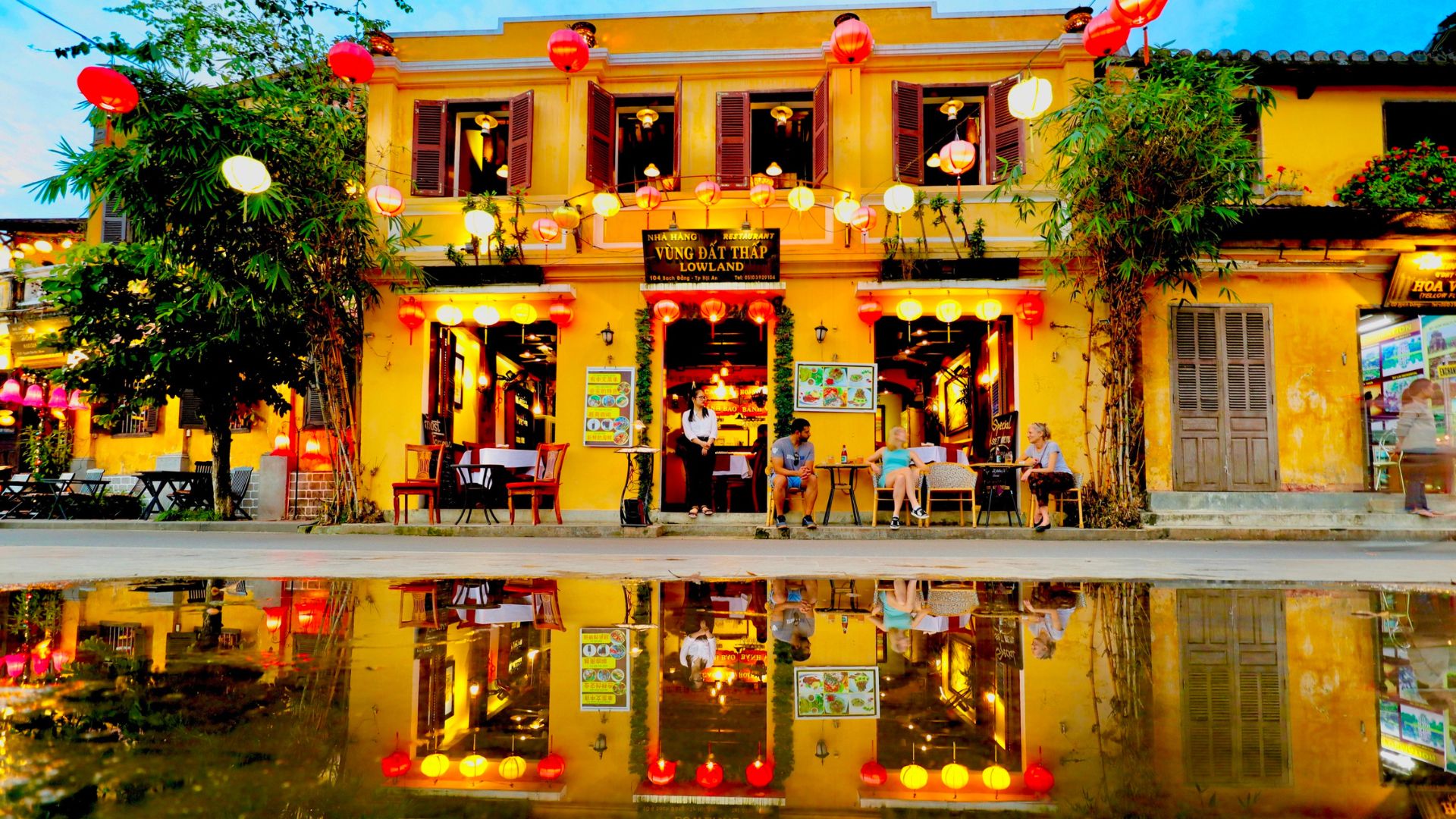
Let me tell you a secret about my town.
Hoi An is the most beautiful place in Vietnam to get gently, politely, smilingly overcharged. Nobody will rob you here. They’ll just charge you double with the warmest smile you’ve ever seen, and you’ll say thank you.
I’ve watched it happen ten thousand times from my morning coffee stool. And honestly? It breaks my heart a little, because the real Hoi An — the one that costs almost nothing — is standing right behind the expensive one, waiting.
So this is not a “top 10 things to do” list. This is me grabbing your arm before you walk into the lantern-lit trap, saying: wait, wait, let me show you how we do it.
⏰ TIMING IS EVERYTHING (SERIOUSLY, IT’S 80% OF THE GAME)
Here’s the thing nobody tells you: Hoi An is two completely different cities depending on the clock.
At 6 AM, the Ancient Town is mine. It’s yours too, if you can drag yourself out of bed. The air still smells of river mud and wet stone, the yellow walls glow soft gold, and the only sound is bicycle bells and the slap of sandals on 200-year-old tiles.
No ticket checkers. No tour flags. No one selling you anything, because they’re all eating breakfast noodles like normal humans.
Walk the same streets at 7 PM on a Saturday and you’re in a human river moving at 0.5 km per hour, sweating into strangers, while someone waves a laser toy at your face. Same town. Completely different planet.
My rule: Ancient Town before 8 AM or after 10 PM. The middle of the day belongs to the beach, the rice fields, or a hammock. The 4–9 PM window on weekends belongs to people who didn’t read this article.
One exception: full moon nights. On the 14th day of each lunar month, the town cuts the electric lights and everything runs on lanterns and candles. It’s crowded, yes. It’s also genuinely magical, and I say that as a cynical local. In 2026, check the lunar calendar before you book — if your trip can touch a full moon night, make it happen.
🎫 THE TICKET QUESTION EVERYONE WHISPERS ABOUT
Okay, let’s talk about the famous Ancient Town ticket, because tourists discuss this like it’s a conspiracy.
The official entrance ticket is 120,000 VND (about $4.70). It funds the restoration of the old houses, and it includes entry to 5 heritage sites of your choice from the full list below.
And that list is longer than most people realize. Your ticket covers:
- Cultural landmarks: the Japanese Covered Bridge (Chua Cau), Quan Cong Temple, Cam Pho Communal House, and Tuy Tien Duong Minh Huong.
- Ancient houses: Phung Hung, Duc An, and Quan Thang — merchant homes where the same families have lived for generations.
- Family chapels: the Tran Family Chapel and the Nguyen Family Chapel.
- Museums: the Museum of Folk Culture, the Museum of Trade Ceramics, the Sa Huynh Culture Museum, and the Hoi An Museum.
- Assembly halls: Fujian (Phuc Kien), Trieu Chau, Quang Trieu, and Hai Nam — the ornate Chinese congregation halls with the dragon fountains everyone photographs.
- Japanese merchant tombs: Gu Sokukun, Tani Yajirobei, and Banjiro — quiet, mossy, and almost always empty.
And one thing almost everyone misses: the ticket includes a traditional art performance at the Xu Dang Trong theater, twice daily at 10:15 AM and 3:15 PM. Live folk music and dance for zero extra dong. Locals know; tour groups somehow never do.
My picks if you’re choosing just 5: Fujian Assembly Hall, one ancient house (Phung Hung), the Museum of Trade Ceramics, the Japanese Covered Bridge, and the 3:15 performance. That’s the whole arc of Hoi An’s story in one afternoon.
Here’s the honest truth: the ticket booths sit at the main entrances to the pedestrian zone, and enforcement is… let’s call it “moody.” Early morning and late night, the booths are usually empty. Midday and evening, they check.
My advice as a local? Just buy it. It’s the price of one cocktail back home, it goes to keeping my town from falling into the river, and it saves you that awkward shoulder-tap moment mid-photo. Buy it once, keep the paper stub, and it’s valid across your visit.
What you should NOT pay for: anyone on the street “selling tickets” away from the official yellow booths. Official booths only. If someone approaches you holding tickets, smile, say “no, thank you,” and keep walking.
👗 THE TAILOR GAME: HOW NOT TO GET STITCHED UP
Hoi An has more tailors than residents, I’m convinced. Somewhere between 400 and 600 shops, all promising the suit of your dreams.
Some of them will genuinely change your relationship with clothing forever. Some will sell you a costume that dissolves in the first wash. The trick is knowing the difference.
Real prices in 2026: a properly made two-piece suit runs $120–250 depending on fabric. A tailored áo dài, $40–80. A simple dress or shirt, $25–50. If someone quotes you a “special price” suit at $60, the fabric is the special part — specially bad.
The red flags, memorize these: any shop where a tout pulled you in off the street. Any shop promising a full suit “ready in 4 hours.” Any shop that won’t do a second fitting. Good tailoring needs 2–3 days and at least two fittings, where they pin, adjust, and pin again.
The feeling of a good tailor shop is unmistakable: fabric bolts stacked to the ceiling, the smell of chalk and fresh cotton, a woman with a measuring tape around her neck who looks at your shoulders before she looks at your wallet.
Come on day one of your trip, not your last day. Give the process the time it deserves, and you’ll fly home with the best-fitting thing you’ve ever owned.
🛶 LANTERNS, BOATS, AND THE ART OF THE POLITE HAGGLE
The lantern boat ride on the Thu Bon River is objectively touristy and I don’t care — it’s lovely. Floating between hundreds of glowing paper lanterns while the old town reflects in black water? Even locals do this on anniversaries.
But here’s where the walking-wallet tax gets aggressive.
The fair price in 2026: around 150,000–200,000 VND (about $6–8) for a 20-minute ride for two people. The opening quote you’ll hear at peak hour: 300,000–500,000 VND, delivered with total confidence.
How to haggle without being a jerk: smile first, always. Offer 150,000 for two people, be ready to settle around 200,000, and if the answer is no, walk five meters — there are forty more boats. The walk-away is the negotiation. Nobody is offended; this is the dance, and doing it with a smile is respected here.
The floating paper lanterns sold on the bank are 10,000–20,000 VND each. Pay the small lady with the bamboo basket, not the guy who intercepts you first.
Want to take a real lantern home? The silk-and-bamboo lanterns in the shops run anywhere from 30,000 VND for a simple small one to 2,000,000 VND (~$80) for the large hand-embroidered showpieces. The foldable travel-friendly ones sit in the 80,000–150,000 VND range — and yes, the price is haggle-able, same rules as the boats.
Pro move: take the boat at 5:30 PM, just before full dark. You get the blue-hour light, the lanterns switching on around you, and prices that haven’t hit their 8 PM peak yet.
🍜 EAT WHERE THE MOTORBIKES ARE PARKED
Here is my one universal rule, and it has never failed a single visitor I’ve given it to: eat where the motorbikes are parked, not where the menus have photos.
Inside the Ancient Town, a bowl of cao lầu — our sacred noodle dish, chewy noodles, char siu pork, crispy crackers, herbs from Tra Que village — will cost you 70,000–90,000 VND on a photo menu.
Walk ten minutes out of the heritage zone, and the exact same bowl, arguably better, is 30,000–40,000 VND (about $1.20–1.60). Served on a metal table, on a plastic stool, with the sound of a wok firing behind you and the smell of star anise and grilled pork drifting into the street.
That plastic stool is not a downgrade. That plastic stool is the entire point of Vietnam.
For the full breakdown of what to order — cao lầu, cơm gà, white rose dumplings, mì Quảng, and the street desserts that will ruin you — I already wrote you a whole love letter: read our guide to the 5 Hoi An dishes that will ruin all other food for you. Consider it the food companion to this survival guide.
Budget reality check for 2026: a full, glorious street food meal — main dish, dessert, drink — should land around 100,000–200,000 VND total ($4–8). If you’re spending more than that per meal every day, you’re eating in the wrong postcode.
🏖 THE ESCAPE ROUTES (WHERE LOCALS ACTUALLY GO)
When the midday heat presses down like a wet blanket — and it will, this town’s humidity has a personality — you need exit strategies.
An Bang Beach, 6:30 AM. Before the sunbed sellers set up, the beach belongs to swimming grandmothers and fishermen dragging in round basket boats. The water is soft, the light is pink, and a fresh coffee at a beach shack costs 30,000 VND, not the 90,000 the afternoon crowd pays for the same view.
The Cam Thanh coconut palm forest is beautiful and has been fully discovered — the basket boat tours there now come with karaoke speakers, which is a crime against nature. Go anyway, but go before 9 AM, ask for “no music” with a smile, and pay around 150,000–200,000 VND per boat, not the 500,000 someone will absolutely try first.
And the single most underrated thing in Hoi An: rent a bicycle. Around 30,000–50,000 VND a day from almost any homestay. Pedal out through the Cam Chau rice paddies at 5 PM, when the light turns everything green-gold and water buffalo stand around like they own the place. Because they do.
You will smell rain coming before it arrives. You will hear frogs, wedding music from a village party, and absolutely zero tour guides. This costs $1.50 and it will be your favorite memory. I’d bet money on it.
💤 WHERE TO SLEEP (ONE HONEST PARAGRAPH)
Quick version: staying inside the Ancient Town sounds romantic and is mostly a mistake — you pay heritage prices for thin walls and evening crowd noise. The sweet spot is the Cam Chau and An Bang area: rice-field homestays and small villas at $25–50 a night, ten minutes by bicycle from everything. Da Nang day-trippers, you can also base yourself up the coast — see our Da Nang guide for that math.
💸 THE WALKING-WALLET CHEAT SHEET
Print this. Screenshot it. Tattoo it on your arm, I don’t care.
- Ancient Town ticket: 120,000 VND (~$4.70) — official booths only
- Cao lầu outside the old town: 30,000–40,000 VND (~$1.20–1.60)
- Bánh mì: ~25,000 VND (~$1)
- Vietnamese coffee: ~30,000 VND (~$1.20)
- Full street food meal: 100,000–200,000 VND (~$4–8)
- Lantern boat for two: 150,000–200,000 VND (~$6–8)
- Floating paper lantern: 10,000–20,000 VND (~$0.40–0.80)
- Souvenir silk lantern: 30,000 VND – 2,000,000 VND depending on size and handwork (~$1.20–80)
- Bicycle rental, full day: 30,000–50,000 VND (~$1.20–2)
- Basket boat, Cam Thanh: 150,000–200,000 VND (~$6–8)
- Tailored suit, real quality: $120–250
If someone quotes you dramatically above these numbers, you’re not being robbed. You’re being tested. Smile, counter, or walk. The town respects all three.
🌙 ONE LAST THING, FROM ME TO YOU
Hoi An will try to turn you into a walking wallet. That’s just what happens when a small town this beautiful meets this many visitors.
But the town doesn’t want your money as much as it wants your attention. Sit on the low stool. Take the 6 AM walk. Learn to say “cảm ơn” (thank you) and watch faces change.
The travelers who get overcharged here are almost always the ones moving too fast to notice anything. Slow down to Hoi An speed, and the town practically starts giving itself away.
See you at the noodle stall. I’ll be the one on the smallest stool, ordering a second bowl.